Introduction
Large animal work happens in barns, chutes and grassy paddocks, often far from a hospital. The veterinary technician draws up drugs, keeps the treatment record, holds the head, preps the surgery site and watches the patient wake up. Two things make this work different from small animal practice. First, cattle, sheep, goats and pigs are food animals, so every drug given can leave a residue in meat or milk. Second, most surgery is done standing under local blocks or under short injectable field anesthesia. This guide covers AMDUCA and the drugs banned in food animals, residue avoidance, xylazine and ketamine field anesthesia and "triple drip", the cornual, inverted L and paravertebral blocks, castration assisting, and horse recovery.
Key facts
- Under AMDUCA, extralabel drug use must be by or on the lawful order of a veterinarian within a valid veterinarian-client-patient relationship (VCPR).2
- Extralabel use to enhance production is not permitted. It is limited to cases where the animal's health is threatened or suffering or death may result without treatment.2
- Chloramphenicol, clenbuterol, diethylstilbestrol, the nitroimidazoles, furazolidone, nitrofurazone, fluoroquinolones and glycopeptides are prohibited from extralabel use in food-producing animals.1
- FARAD (Food Animal Residue Avoidance Databank) is the first stop for deciding whether a drug can be used in a food animal and what withholding time applies.23 3
- Cattle are very sensitive to xylazine and need only about one tenth of the equine dose.6
- "Triple drip" combines guaifenesin (a muscle relaxant), ketamine and xylazine to maintain field anesthesia.13
- The proximal paravertebral block targets spinal nerves T13, L1 and L2; the inverted L block places two lines of lidocaine behind the last rib and below the lumbar transverse processes.4
- Small ruminants are much more sensitive to lidocaine than cattle. A common upper limit is about 4 to 5 mg/kg.411
How the VTNE tests this
- Identify a drug that may never be used extralabel in a food animal, or state who may authorize extralabel use (Domain 1 Tasks D and E).
- Explain a withdrawal or milk discard time to a producer and record it correctly (Domain 1; K10).
- Calculate a dose or a maximum safe volume, for example xylazine for a horse or lidocaine for a goat (Domain 1; Domain 7 Task B).
- Name the nerves or landmarks for a cornual, inverted L or paravertebral block (Domain 7 Task B).
- Choose the safe action during field anesthesia, castration or recovery of a horse (Domain 7 Task B).
Core concepts
AMDUCA and extralabel drug use
Extralabel drug use (ELDU) means using an approved drug in a way the label does not state. That includes a different species, indication, dose, frequency or route, and changing the labeled withdrawal time because of those differences.2 The Animal Medicinal Drug Use Clarification Act of 1994 (AMDUCA) and its rules in 21 CFR 530 allow ELDU only by or on the order of a veterinarian within a valid VCPR.2 In food animals, extra conditions apply. For example, no approved animal drug with the same active ingredient in the needed form and concentration may exist, unless the veterinarian finds it clinically ineffective. The veterinarian must also make sure withdrawal times are met and no illegal residues occur.2 Any ELDU that leaves a residue above the safe level or tolerance is not allowed.2
Withdrawal time and residue avoidance
A withdrawal (withholding) time is the period after the last dose before meat can go to slaughter or milk can be sold. Label withdrawal times apply only to labeled use. When a drug is used extralabel, the veterinarian sets a longer, science-based time. FARAD's WDI (withdrawal interval) lookup helps with meat and milk withholding times for drugs used outside the label in a fairly standard way.3 Sheep, goats and camelids are food animals too, but they are minor species with different guidelines. Most pot-bellied pigs are not kept as food animals, but they are still swine and must meet federal rules for a major species.23
| Drug or class | Scope of the ban |
|---|---|
| Chloramphenicol | All food-producing animals |
| Clenbuterol | All food-producing animals |
| Diethylstilbestrol (DES) | All food-producing animals |
| Dimetridazole, ipronidazole and other nitroimidazoles (for example metronidazole) | All food-producing animals |
| Furazolidone, nitrofurazone | All food-producing animals |
| Fluoroquinolones | All food-producing animals |
| Glycopeptides | All food-producing animals |
| Sulfonamides | Lactating dairy cattle (except approved use of sulfadimethoxine, sulfabromomethazine and sulfaethoxypyridazine) |
| Phenylbutazone | Female dairy cattle 20 months of age or older |
| Cephalosporins (not cephapirin) | Cattle, swine, chickens, turkeys: for prevention, at unapproved dose, frequency, duration or route, or if not approved for that species and production class |
| Adamantanes, neuraminidase inhibitors | Chickens, turkeys and ducks |
Source: 21 CFR 530.41.1 Merck treats metronidazole as the prototype nitroimidazole, so it is covered.22
Sedation and field anesthesia
Field anesthesia in ruminants is typically safe for up to about 60 minutes; after that, complications are more likely.5 The pattern is sedation (usually xylazine), then induction (ketamine, tiletamine-zolazepam or guaifenesin), then maintenance by repeat doses or an infusion.5 Alpha-2 agonists such as xylazine can cause heart block, so the heart is auscultated before they are given. They can cause fatal pulmonary edema in sheep, and xylazine can cause abortion in cattle in the third trimester.6
Most recumbent equine castrations use xylazine with ketamine. Butorphanol, a benzodiazepine or guaifenesin can be added to lengthen the effect and smooth recovery.8 Diazepam can be mixed with ketamine but not with xylazine.8
"Triple drip" (GKX) is a dissociative (ketamine), an alpha-2 agonist (xylazine, romifidine or detomidine) and a centrally acting muscle relaxant (guaifenesin).13 In one mule study, 1 g of ketamine and 500 mg of xylazine were added to a 500 mL bag of 5% guaifenesin, giving 50 mg/mL guaifenesin, 2 mg/mL ketamine and 1 mg/mL xylazine.13 Overdosed guaifenesin can increase muscle tone, so the animal may look too light when it is actually too deep.5
Local anesthesia
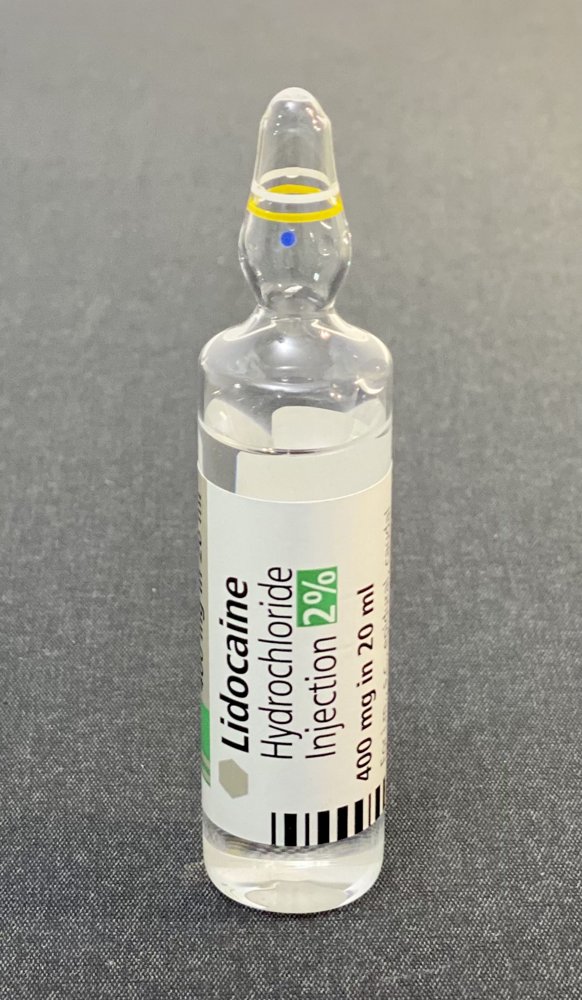
Much bovine standing surgery is done with local anesthesia and added analgesics, sometimes without sedation.4 Lidocaine is the main agent. Small ruminants and camelids are much more sensitive than cattle; horses are relatively insensitive. The UMN notes give upper doses of 4 to 5 mg/kg for sheep and goats and 8 mg/kg for cattle and horses.4 Diluted lidocaine still works but for a shorter time.4
| Block | Used for | Landmark and technique |
|---|---|---|
| Cornual nerve block | Disbudding or dehorning calves | Lidocaine around the cornual branch of the zygomaticotemporal nerve along the temporal ridge (groove), between the lateral canthus and the horn bud |
| Cornual block, goat | Disbudding kids | Lidocaine under the skin over a cornual nerve branch dorsomedial to the eye, next to the margin of the orbit; keep the total dose low |
| Line block | Flank incision; the easiest block to perform | Lidocaine injected along the line of the planned incision; it distorts the tissue planes |
| Inverted L block | Standing flank laparotomy | Two long lines: one just behind the last rib, one below the lumbar transverse processes; keeps drug out of the incision |
| Proximal paravertebral | Standing flank laparotomy | About 20 mL lidocaine per site at T13, L1 and L2, near where the nerves leave the spine |
| Distal paravertebral | Standing flank laparotomy | 10 to 20 mL per site at the tips of the transverse processes of L1, L2 and L4 |
| Caudal epidural | Perineal procedures | Sacrococcygeal space (the most movable space when the tail is pumped); about 5 mL lidocaine in an average dairy cow |
Sources: UMN Large Animal Surgery notes4; D'Anselme et al.19; AVMA20; Sheedy et al.15; Navarre (dvm360)18; Osorio-Santos et al.16
When a proximal paravertebral block works, the cow bends toward the opposite side as the flank muscles relax, and the flank feels warmer from vasodilation.4 Xylazine at 0.02 mg/kg can be mixed into inverted L and paravertebral lidocaine to lengthen the block and add sedation.4
Procedure or technique
Assisting a field castration of a horse
- Check the patient. The colt should be healthy, manageable and have two descended testicles. Never remove a lone testicle.9
- Check tetanus status. Tetanus toxoid within the past 6 months is usually adequate; otherwise boost. Tetanus antitoxin has been linked to serum hepatitis and equine parvovirus infection.9
- Set up. Choose a grassy field away from roads, buildings and other animals. Stalls and sand are poor choices.9 Pack anesthetic drugs, lidocaine, an NSAID, an antibiotic, tetanus toxoid, scrub supplies, a surgery pack with emasculators, and suture even if you do not plan to use it.7
- Give preoperative drugs as ordered: an NSAID before surgery; preoperative penicillin or ceftiofur may lower complication rates.89 Place an IV catheter if the veterinarian wants one.
- Induce and position. After the horse goes down, remove the halter to protect the facial nerve and pad to protect the radial nerve.710 Control the head to control the horse. Work from the back side, out of the kick zone.8
- Assist surgery. The veterinarian places lidocaine in the testicle or cord.9 Hand over the emasculator assembled correctly, "nut to nut", so the crush is proximal and the cut distal. It is usually left on for about 2 minutes.10
- Recover. Make sure the last drug given was a sedative, not ketamine. Stay out of the way.7
- Discharge. Incisions are left open to drain. Tell the owner that exercise reduces swelling, which is the most common complication and peaks at 2 to 3 days.810
Preparing a food animal for field anesthesia or standing surgery
- Where possible, hold adult cattle off feed for about 24 hours and small ruminants about 18 hours, and withhold water for the last 12 hours, to reduce rumen fill.5
- Record the weight. Calculate the lidocaine ceiling before the block and dilute with saline if needed for volume.4
- Under general anesthesia, keep the nose lower than the poll, with a pad under the neck, so saliva and rumen contents drain out. Atropine only makes saliva thicker.5
- Watch for bloat, since ruminants develop rumen stasis under anesthesia. Recover them in sternal recumbency, which also lowers aspiration risk.5
- Record every drug, dose, route, site and the withdrawal date in the treatment record.2
Flowchart: when can a treated food animal be sold or milked?
Species differences
- Dog and cat: AMDUCA also covers companion animals, but the food-animal extra conditions and the prohibited list do not apply to them.12 Cats have the lowest lidocaine ceiling in the UMN table, 2 mg/kg.4
- Horse: Horses go through a more eventful excitement phase than ruminants do.5 Horses are relatively insensitive to lidocaine.4
- Cattle: very sensitive to xylazine (about one tenth of the equine dose) but not more sensitive to detomidine.6 Triple drip works very well in cattle.5
- Sheep: avoid alpha-2 agonists where possible because of pulmonary edema.6
- Goats: very sensitive to pain and to lidocaine. Lidocaine-infused castration bands exceed the toxic dose for most young kids and lambs. Goats are prone to tetanus and need vaccination.11 Barnes dehorners should not be used on goats because of their softer skull.12
Calculation
Worked example 1: xylazine for a horse. A 500 kg horse is to receive xylazine at 1.1 mg/kg IV. The product is 100 mg/mL. (The Anased label gives 0.5 mg/lb IV, which equals 1.1 mg/kg.)17
Dose: 500 kg x 1.1 mg/kg = 550 mg. Volume: 550 mg / (100 mg/mL) = 5.5 mL.
Worked example 2: lidocaine ceiling for a goat. A 30 kg goat needs a block. Using 4 mg/kg as the upper limit and 2% lidocaine (20 mg/mL):11
Maximum dose: 30 kg x 4 mg/kg = 120 mg. Maximum volume: 120 mg / (20 mg/mL) = 6 mL. If the veterinarian needs more volume, dilute with sterile saline; the block will be shorter.4
Recovery of horses
Recovery remains the most dangerous phase of general anesthesia in horses.14 In field castrations, recoveries in an open grassy field are generally low risk. Finishing with xylazine or romifidine at about a quarter dose can smooth recovery.8 In a study of mares anesthetized for dystocia, a small dose of an alpha-2 agonist for recovery carried a much lower risk of death than an alpha-2 agonist plus ketamine.14 In hospitals, head and tail ropes are the most common method used to assist recovery after osteosynthesis (54% in one survey).14 The technician's jobs are to keep the area clear, stay out of the kick zone and report a horse that keeps trying to stand too early.
Safety, legal and client education
- Only a veterinarian, within a valid VCPR, may authorize extralabel use. A technician may not change a dose or route on a producer's request.2
- Tell the producer the exact date and time meat or milk can be released, and write it on the label and record. Count from the last dose.
- If a drug is not in FARAD's tools, the veterinarian can contact FARAD directly.3
- After disbudding with caustic paste, keep calves from nursing until the paste dries, because it can burn the dam's udder. Rain can wash paste into the eye.12
- Explain to horse owners that heavy bleeding for an hour or more, or anything hanging out of the incision, needs immediate veterinary attention. Persistent arterial bleeding is treated by re-anesthetizing the horse to find and ligate the artery.10 Cold hosing is fine if the horse tolerates it, but the water should not be aimed up into the incisions.10
- The client should play a minimal role; trained staff handle the horse.9
Common mistakes and exam traps
- Thinking extralabel use is allowed to improve growth or production. It is not.2
- Assuming phenylbutazone is banned in all cattle. The ban is for female dairy cattle 20 months or older; sulfonamide limits apply to lactating dairy cattle.1
- Giving a cow the horse dose of xylazine. Cattle need about one tenth.6
- Using the cattle lidocaine ceiling for a goat kid. Small ruminants tolerate far less.4
- Leaving the halter on a recumbent horse. It can cause facial nerve paralysis.10
- Ending field anesthesia with ketamine. The last drug should be a sedative.7
Memory aids
"Twelve, One, Two for the flank": T13, L1, L2 are the nerves for the proximal paravertebral block. (memory aid)
"Rib and roof": the inverted L runs behind the last rib and under the "roof" of the lumbar transverse processes. (memory aid)
"Cows get a tenth": cattle need about one tenth of the equine xylazine dose. (memory aid)
"G for grip loosens": in triple drip, guaifenesin is the muscle relaxant; ketamine is the dissociative and xylazine the alpha-2 sedative. (memory aid)
"Finish on a sedative": the last drug before a horse recovers should be a sedative, not ketamine. (memory aid)
Quick review
- AMDUCA allows extralabel use only on a veterinarian's order within a valid VCPR.
- Extralabel use for production purposes is not allowed.
- Chloramphenicol, fluoroquinolones, nitroimidazoles, nitrofurans, DES, clenbuterol and glycopeptides are banned extralabel in food animals.
- Phenylbutazone is banned in female dairy cattle 20 months or older.
- FARAD helps set withholding times for extralabel use.
- Withdrawal is counted from the last dose.
- Cattle need about one tenth of the horse xylazine dose; avoid alpha-2 agonists in sheep where possible.
- Triple drip is guaifenesin, ketamine and xylazine.
- Cornual block: along the temporal ridge between the lateral canthus and the horn bud.
- Inverted L: behind the last rib and below the lumbar transverse processes; proximal paravertebral: T13, L1, L2.
- Remove the halter after induction; finish with a sedative; recover in a grassy field.
- Recover ruminants sternal, nose down, and watch for bloat.