Introduction
A dental procedure runs on two kinds of tools. Hand instruments (probes, explorers, scalers, curettes, luxators, elevators and forceps) let you feel, measure and remove. Power equipment (ultrasonic and sonic scalers, high-speed and low-speed handpieces, and the compressor that drives them) does the heavy work faster, but it can heat and damage a tooth if it is misused.2
The credentialed technician sets up the dental tray, scales and polishes, hands the right extraction instrument to the veterinarian, and keeps every instrument sharp and every handpiece oiled. This guide covers what each instrument looks like, where it is used, what it must never be used for, how power scalers differ, how to sharpen and test hand instruments, and the routine care of handpieces and the dental unit.
Key facts
- A sickle scaler has a sharp pointed tip and is for supragingival (above the gumline) calculus only. Using it below the gumline can damage the gingiva and periodontal ligament.1
- A curette has a rounded toe and rounded back, so it is the hand instrument used subgingivally (below the gumline) for root planing.12
- Keep an ultrasonic scaler on one tooth for no more than 15 seconds, and keep water flowing. Heat damage is mostly caused by lack of water cooling.3
- Ultrasonic scalers vibrate at about 25,000 to 45,000 Hz. Sonic scalers run on compressed air at only 2,000 to 6,500 Hz.3
- Polish one tooth for a maximum of five seconds at a time to avoid overheating.3
- Luxators cut the periodontal ligament and must not be twisted for leverage. Elevators use apical pressure plus rotation.1
- High-speed handpieces run at 300,000 to 400,000 rpm; low-speed handpieces for polishing run at 5,000 to 20,000 rpm.2
- Curettes are sharpened with the face at a 110 degree angle to the stone, heel to toe, keeping the toe rounded.4
How the VTNE tests this
- Name the instrument for the job: supragingival versus subgingival scaling, cutting the periodontal ligament versus lifting the tooth. Domain 3 Task B (prepare and maintain the environment, equipment, instruments and supplies to meet the needs of the dental team and patient).6
- Spot the unsafe technique: a scaler tip left on one tooth, water turned off, a sickle scaler in a pocket, a luxator used as a lever. Domain 3 Task C (perform the Comprehensive Oral Health Assessment and Treatment, COHAT, including scaling and polishing, manual and machine).6
- Care and maintenance: sharpening angle, testing for sharpness, oiling handpieces, draining the compressor tank. Dentistry is 10 items, about 7% of the exam.6
Core concepts
Parts of a hand instrument
Every hand instrument has a handle (where you hold it), a shank (which connects the handle to the working end) and a working end (the blade or probe that touches the tooth).2 Most periodontal hand instruments are held with a modified pen grasp, with the middle finger near the end of the shank to feel the tooth.3
Diagnostic instruments: probe and explorer
The periodontal probe measures gingival sulcus and pocket depth and the size of any abnormality in the mouth.1 Probes are a tapered rod with a blunt end and millimeter markings; the Williams, Marquis, Michigan-O, UNC and Nabors are common types.3 Markings vary. One notched style marks 1, 2, 3, 5, 7, 8, 9 and 10 mm (it skips 4 and 6), and banded probes use 3 mm bands, so know what your own probe measures.14
The explorer has a fine, flexible, sharp tip that glides over the tooth to feel for calculus, plaque, caries and exposed pulp. The shepherd's hook is the most common explorer in veterinary practice.12 Many instruments carry an explorer on one end and a probe on the other.1
Scalers versus curettes
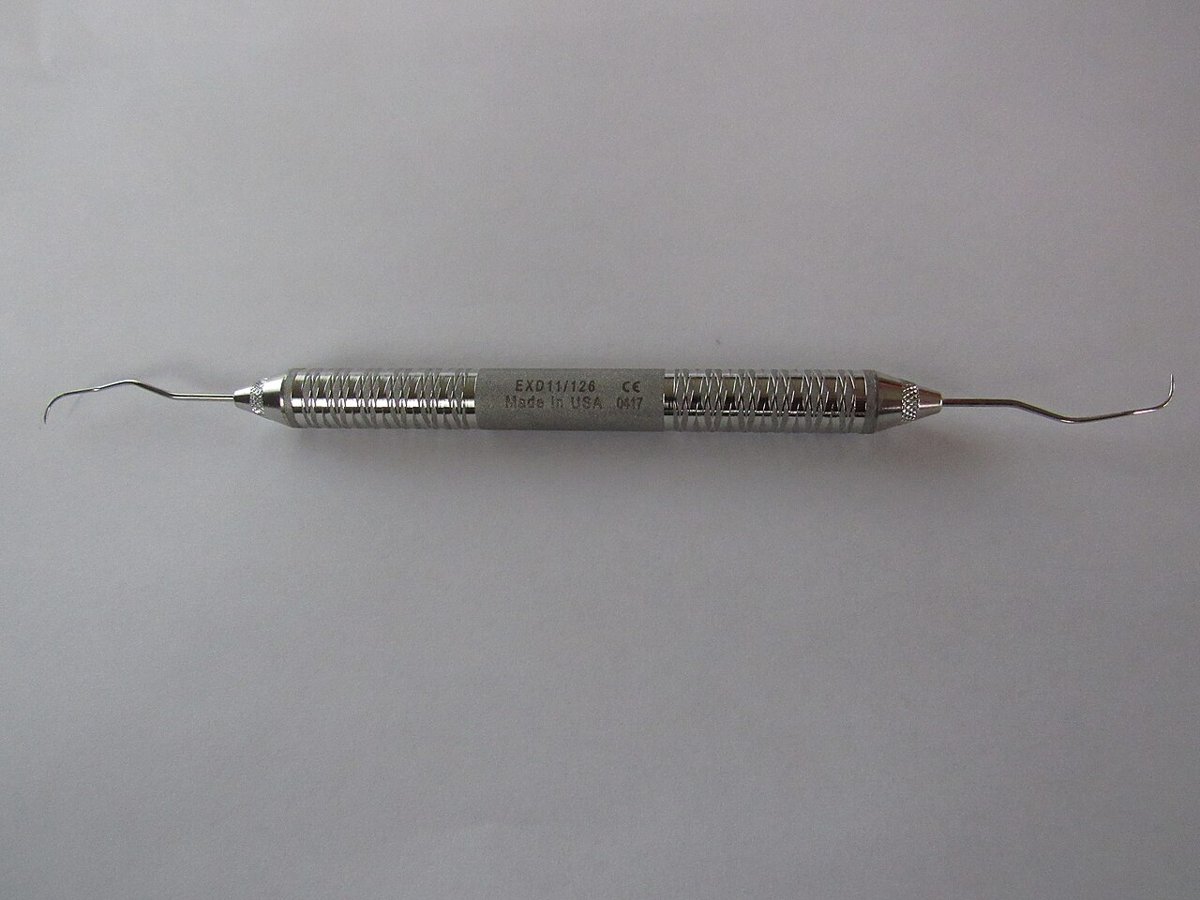
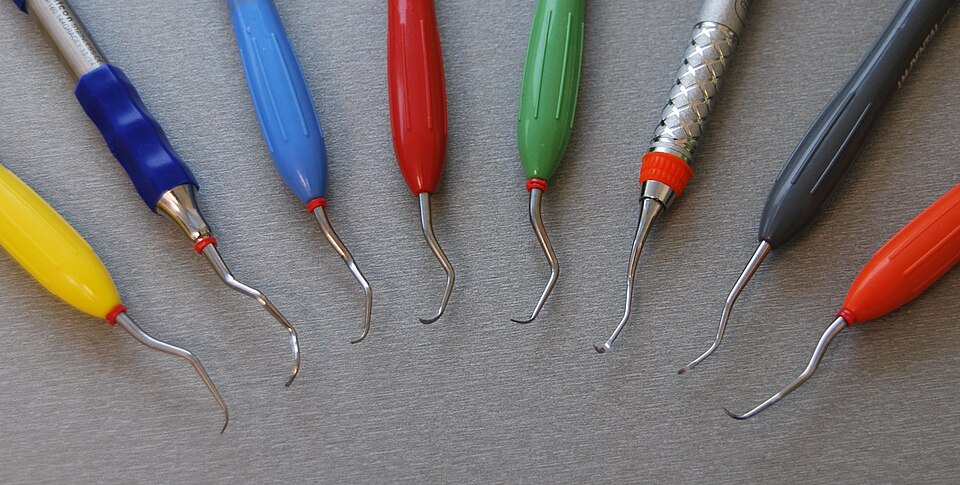
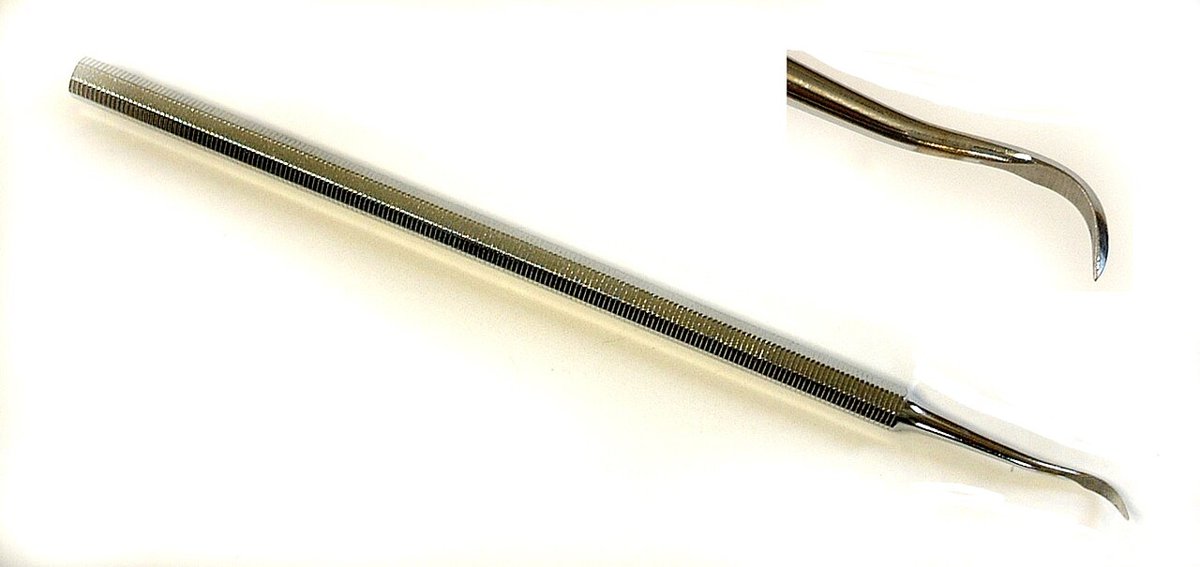
The sickle scaler has a sharp tip, two cutting edges and a flat face between them; seen tip-on, the blade looks like a triangle.12 It is used only to remove supragingival calculus. The sharp back and tip can easily cut the gingiva, so it never goes into a pocket.3
The curette has a rounded back and a blunt, rounded toe. It is used below the gumline for root planing (removing subgingival calculus and a layer of cementum to smooth the root) and for gingival curettage.12 The blunted bottom will not cut through the delicate periodontal attachment.3
A universal curette (for example Columbia or Barnhart) can be used throughout the mouth and its face is at 90 degrees to the handle. A Gracey curette is area specific, has one cutting edge and an angled blade; lower numbers fit incisors and canines, higher numbers fit premolars and molars.24
Calculus removal forceps
Calculus (tartar) removal forceps take off large pieces of calculus quickly. The longer tip goes over the crown and the shorter curved tip under the edge of the calculus; squeezing the handles shears it off. Take care not to damage enamel or gingiva.1
Power scalers
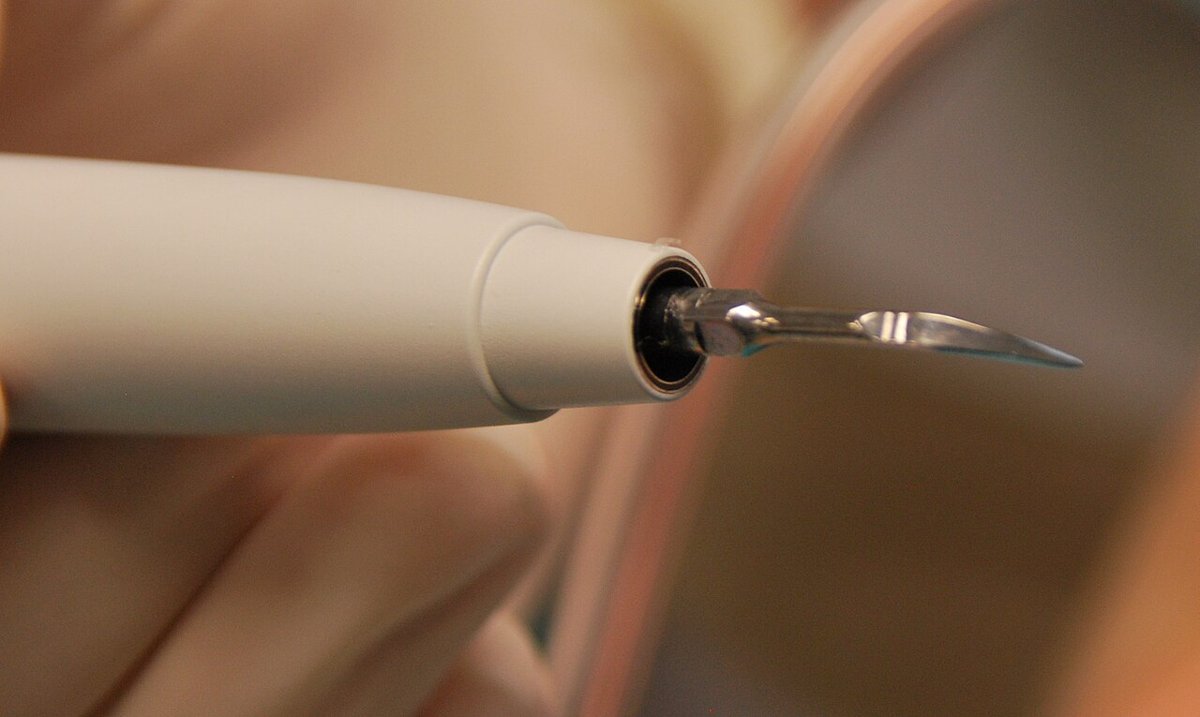
Ultrasonic scalers are the most common mechanical scalers in veterinary dentistry and come in two types, magnetostrictive and piezoelectric.3
- Magnetostrictive: an insert of stacked nickel strips (or a ferrite rod) vibrates inside the handpiece. Stacked inserts move the tip in an elliptical pattern at 25 or 30 kHz; ferrite rods move in a circle at 42 kHz. Water flows through the handpiece and out the tip to cool it.2
- Piezoelectric: quartz crystals in the handpiece expand and contract, giving a back and forth (linear) tip motion at about 45 kHz. Tips screw onto a metal base.2
- Sonic: driven by compressed air at 2,000 to 6,500 Hz. The air has a cooling effect, so sonic scalers are less likely to cause heat damage, but they work more slowly.23
| Type | Driven by | Frequency | Tip motion |
|---|---|---|---|
| Magnetostrictive (stacked strips) | Stacked nickel strip insert | 25 or 30 kHz | Elliptical |
| Magnetostrictive (ferrite rod) | Ferrite rod insert | 42 kHz | Circular |
| Piezoelectric | Quartz crystals in the handpiece | About 45 kHz | Back and forth |
| Sonic | Compressed air | 2,000 to 6,500 Hz | Slower vibration, cooler running |
Sources: dvm360 proceedings (ref 2), WSAVA Global Dental Guidelines (ref 3).
Ultrasonic units also create an antibacterial effect in the coolant spray, called cavitation.3 Rotosonic scaling is no longer recommended because it leaves a much rougher tooth surface than hand or ultrasonic and sonic scaling.3
Handpieces and prophy angles
The high-speed handpiece runs at 300,000 to 400,000 rpm and is used to section teeth and remove alveolar bone during extractions. It has a water spray to cool the bur.2 A crosscut fissure bur (701 or 701L) sections teeth; round burs remove bone.2
The low-speed handpiece runs at 5,000 to 20,000 rpm and is used mainly for polishing. The prophy angle attaches to it and carries a soft rubber prophy cup filled with prophy paste. Leaving the cup on a tooth too long can cause thermal damage to the pulp.2
Extraction instruments
| Instrument | Working end | Use | Do not |
|---|---|---|---|
| Periodontal probe | Blunt, tapered, mm markings | Measure sulcus and pocket depth | Assume every probe has the same markings |
| Explorer (shepherd's hook) | Fine, sharp, flexible point | Feel for plaque, calculus, caries, exposed pulp | Use it to scale |
| Sickle scaler | Pointed tip, two edges, triangular | Supragingival calculus | Put it below the gumline |
| Curette | Rounded toe and back | Subgingival scaling, root planing | Let the toe become pointed when sharpening |
| Luxator | Very thin, sharp, flat blade | Cut the periodontal ligament | Twist or lever (the tip bends or breaks) |
| Elevator (often winged) | Thicker, rounded scoop, sharp edge | Stretch and tear the periodontal ligament with pressure and rotation | Use a dull one; it will not enter the ligament space |
| Extraction forceps | Small jaws shaped to the tooth | Lift out a tooth already loosened | Pull a tooth that is not yet mobile |
| Periosteal elevator | Spoon or triangle with sharp edges | Separate the periosteum from bone to raise a mucoperiosteal flap | Let the edges dull or dent; examine them regularly |
Sources: OSU CVM Clinical Skills Handbook (ref 1), dvm360 proceedings (ref 2), Lobprise and VanTrease (ref 4).
Luxators are typically used to start an extraction, elevators to continue it, and forceps to remove the tooth.1 Small breed extraction forceps are the most common type; their small size and spring let less force be placed on small teeth, reducing the chance of crown fracture.2 Root tip picks and root tip forceps retrieve fractured root tips, and the alveolar bone curette debrides the socket after extraction.2
Procedure: using an ultrasonic scaler safely
- Wear eyewear, a mask and gloves. Ultrasonic and sonic scalers create bacteria-laden aerosols.3
- Rinse the mouth with 0.12% or 0.2% chlorhexidine gluconate before starting to lower the bacterial load.3
- Set the power low and adjust up only to the minimum needed. Check that a fine but significant water spray comes from the tip.3
- Use the side (flat plane) of the tip, not the point. The area of maximum vibration is 1 to 3 mm from the tip.3
- Use light pressure. Heavy pressure can stop the oscillation entirely.3
- Keep the tip moving in overlapping strokes in different directions, no more than 15 seconds on one tooth.3
- Do not use a traditional ultrasonic tip (especially magnetostrictive) subgingivally; only specialized periodontal tips are made for that. Finish below the gumline with a curette.3
- Replace worn tips. Losing 1 mm of tip reduces efficiency by 25%, and 2 mm by 50%.3
- Polish every scaled surface, no more than five seconds per tooth, because scaling roughens enamel and a rough surface holds plaque.3
Flowchart: choosing the scaling instrument
Sharpening and testing hand instruments
A dull curette burnishes (smooths over) calculus instead of removing it, and a dull elevator will not enter the periodontal ligament space.4 Examine each instrument after every use and sharpen it if the edge is dull; waiting for a monthly sharpening service is not adequate.4 WSAVA advises sharpening periodontal hand instruments at least weekly if they are used regularly.3
- Stone: a flat Arkansas stone, or one with rounded edges or grooves, is usually all you need; a Bates stone has grooves for winged elevators. A sharpening kit contains Arkansas or oil stones and oil.45
- Curette: usually only the one edge that contacts the tooth needs sharpening. Hold the face at a 110 degree angle to the stone and sharpen from heel to toe, keeping the toe rounded.4
- Scaler: keep both edges and the sharp tip.4
- Elevator: sharpen the inner face on the rounded edge of a stone at 30 to 45 degrees, and the back on a flat stone or in a Bates groove.4
- Test: draw the edge across an acrylic test stick (a plastic syringe case also works). A sharp edge grabs; a dull one slides.25
Every sharpening removes metal. A curette's working head becomes thin and fragile and can break, so replace old, worn or damaged instruments on a regular basis.4
Handpiece, scaler and compressor care
- High-speed handpiece, daily: lubricate with 2 to 3 drops of oil in the correct hole at the base. Weekly, remove the turbine and clean the head chamber with isopropyl alcohol.2
- Bur changes: do not overtighten the chuck; it strips the chuck and dulls the bur changer.2
- Sterilizing: clean and oil, place in a peel pack, and sterilize at a maximum of 275 degrees F (135 degrees C). Debris left inside is scorched by the autoclave and damages the turbine. Most metal prophy angles can be autoclaved at 275 degrees F.2
- Air compressor: drain condensation from the storage tank weekly to monthly depending on humidity. Check oil level and color monthly; some compressors need an oil change once a year.2
- Nitrogen-driven units: bleed the nitrogen out of the lines after each day of use.2
- Records: keep equipment manuals and maintenance logs in one central place so all staff can find them.2
- Hand instruments: store them in trays as kits to protect the blades. An ultrasonic bath is the best cleaning method, followed by autoclaving.5
Species differences
Match instrument size to the patient. Round bur sizes for removing bone are generally 1/4 to 2 for cats, 1 to 3 for small dogs and 4 to 6 for large dogs.2 Many sizes of luxator exist so that the blade matches the root.1 Small breed extraction forceps reduce the force on fragile crowns.2
Safety, legal and client education
Staff performing dental procedures need protective eyewear, a mask and gloves because of aerosols.3 Keep your feet off the dental unit pedal while checking a bur.2 When you explain the procedure to a client, say that a full oral exam and dental radiographs are only possible under general anesthesia.3
Common mistakes and exam traps
- Scaler in a pocket. Any answer that puts a sickle scaler subgingivally is wrong. The curette is the subgingival hand instrument.
- Water off or tip parked. Heat from a stationary or dry ultrasonic tip damages the pulp. Look for 15 seconds and constant water.
- Using the point. Use the side of the ultrasonic tip, not the point.
- Luxator as a lever. Luxators cut; elevators lever. Twisting a luxator bends or breaks it.
- Sonic versus ultrasonic. Sonic is slower (2,000 to 6,500 Hz) and air driven; ultrasonic is 25,000 to 45,000 Hz.
- Pointed curette toe. Sharpening must keep the toe rounded, or the curette becomes a scaler.
Memory aids
SCALER = Stays above: a sickle Scaler stays Supragingival; a Curette Can go below the gumline (memory aid).
15 and 5: 15 seconds per tooth for the ultrasonic scaler, 5 seconds per tooth for the polishing cup (memory aid).
L-E-F: Luxator, Elevator, Forceps, the order of a closed extraction (memory aid).
Luxators Lacerate, Elevators Elevate: the luxator cuts the ligament, the elevator stretches it with rotation (memory aid).
110, heel to toe: curette face at 110 degrees to the stone, stroke heel to toe, keep the toe round (memory aid).
Quick review
- Sickle scaler: pointed, triangular, supragingival only.
- Curette: rounded toe and back, subgingival scaling and root planing.
- Ultrasonic scaler: no more than 15 seconds per tooth, constant water, side of the tip, light pressure.
- Magnetostrictive tips move elliptically; piezoelectric tips move back and forth.
- Sonic scalers are air driven, cooler and slower.
- Polish no more than 5 seconds per tooth with the prophy angle on the low-speed handpiece.
- Luxator cuts the periodontal ligament, elevator levers, forceps remove the loosened tooth.
- Sharpen curettes at 110 degrees, heel to toe; test on an acrylic stick.
- Oil handpieces daily, autoclave at no more than 275 degrees F, drain the compressor tank regularly.