Introduction
Every surgery ends with wound closure, and the technician is the one who stocks the suture, reads the packet, opens it onto the field and loads the needle holder. A suture is any strand of material used to hold tissue edges together and give support while the tissue heals.3 The surgeon chooses the material, but you need to know why a monofilament goes in the bladder, why skin gets a cutting needle and why the packet says 3-0.
This guide covers how sutures are classified, how size is written, the common materials and how long they last, needle shapes and points, and the other closure options: staples and tissue adhesive.
Key facts
- Every suture is described by three choices printed on the packet: absorbable or non-absorbable, natural or synthetic, and braided (multifilament) or monofilament.3
- Natural absorbable suture is broken down by phagocytosis and proteolysis. Synthetic absorbable suture is broken down by hydrolysis, which is more predictable.32
- In healthy tissue, poliglecaprone 25, polyglactin 910 and polydioxanone lose 50% of their strength at about 1 to 2, 2 to 3 and 5 to 6 weeks. They are fully absorbed at about 119 days, 56 to 70 days and 180 days.2
- Suture sizes run from 7 (heaviest) down to 12-0 (finest). The more zeros, the thinner and weaker the strand.3
- Taper point needles are used for luminal organs, vessels and subcutaneous tissue. Cutting needles go through dense tissue such as fascia and skin. Reverse cutting is the usual cutting choice.2
- Monofilament has less tissue drag and is less likely to harbor bacteria. Multifilament handles better because it has less memory.2
- Non-absorbable skin sutures are usually removed at 10 to 14 days, though this varies with site and healing.3
- Wounds may be closed with suture, staples or cyanoacrylate tissue adhesive.5
How the VTNE tests this
- Classify a material: is polydioxanone absorbable, is nylon monofilament, is silk natural? Domain 2 Task D (function as a sterile surgical technician); K20 (wound closure, including suture materials and patterns, staples and tissue adhesives).1
- Match the suture to the tissue: bladder, gut, linea alba, subcutaneous tissue, skin, a contaminated wound. Domain 2 Task D; K20.1
- Choose the needle: taper or cutting, and why reverse cutting is used on skin. Domain 2 Task B (prepare equipment, instruments and supplies); K20.1
- Read a size: which is thicker, 2-0 or 4-0, and what size suits a small cat versus a large dog.
- Time suture or staple removal and explain aftercare to the owner. K20.1
Core concepts
Absorbable or non-absorbable
Absorbable suture is designed to break down and be absorbed over a set time. It is used where support is needed only until the tissue can hold itself together. Non-absorbable suture keeps its strength. It is either left in place for good, in tissue that may never regain full strength, or removed once healing is far enough along, as with skin sutures.3
Absorption time is not the same as strength. A suture can still be visible in the tissue long after it has stopped holding anything. That is why sources quote both the time to lose half its tensile strength and the time to full absorption.2 The tissue environment changes these numbers. In one experimental study cited by Mayhew, poliglecaprone 25 soaked in urine infected with Proteus kept only 11 to 14% of its tensile strength by day 14. Polydioxanone lost all measurable strength after 2 weeks in a solution at pH 1.0, the acidity of the stomach.2
Natural or synthetic
Natural sutures come from animal or plant material, such as gut and silk. Their protein causes the most tissue reaction (inflammation) of any suture type. Synthetic polymers cause less reaction, and their strength and absorption are more uniform from patient to patient.3 Chromic gut is plain gut treated with chromic salts to strengthen it and slow absorption.3 Gut has poor knot security and high tissue reactivity, and is no longer a preferred choice.3
Monofilament or multifilament
A monofilament is a single smooth strand. It slides through tissue easily, but it is stiffer and has "memory": it tries to keep the coiled shape it had in the packet, which makes it harder to tie.3 A multifilament is several strands braided or twisted together. It is flexible and easy to handle, but its rougher surface causes "tissue drag", the friction that traumatizes tissue as the strand passes through. Many braided sutures are coated to reduce drag.3
Capillarity is the ability of a strand to soak up and carry fluid along its length. Braided material can wick bacteria into a site.10 Monofilaments such as polypropylene have low capillarity.8 This is why the rule for potentially contaminated tissue is to avoid multifilament suture and use monofilament or absorbable material.3
Knot security and size
Knot security is how well a knot holds without slipping. Smooth monofilaments need more care when tying, and polypropylene has the poorest knot security of the common skin sutures.3 The knot is the weakest point of a continuous suture line, so extra throws are usually placed: one extra at the start and 2 to 3 extra at the end.2
Size is written in the USP (United States Pharmacopeia) system. Sizes 0 and up get thicker as the number rises (1, 2, 3). Sizes below 0 get thinner as the zeros increase, so 4-0 is finer than 2-0.3 For each step up in size, knot volume increases 4 to 6 times and tissue reaction 2 to 3 times. The rule is the smallest suture that is strong enough for the tissue.23
Common materials
| Material (example trade name) | Absorbable? | Construction | Absorption or behavior | Typical use |
|---|---|---|---|---|
| Poliglecaprone 25 (Monocryl) | Yes, synthetic | Monofilament | 50% strength lost at 1 to 2 weeks; absorbed by about 119 days | Subcutaneous and intradermal closure |
| Polyglactin 910 (Vicryl) | Yes, synthetic | Braided | 50% strength lost at 2 to 3 weeks; absorbed by 56 to 70 days | Subcutaneous tissue |
| Polydioxanone (PDS) | Yes, synthetic | Monofilament | 50% strength lost at 5 to 6 weeks; absorbed by about 180 days; stiff | Fascia and other slow-healing tissue; urinary tract (some surgeons) |
| Chromic gut | Yes, natural | Multifilament | Proteolysis; weak, high tissue reaction | Now seldom preferred |
| Nylon (Ethilon) | No, synthetic | Monofilament | Strong, stiff | Skin |
| Polypropylene (Prolene) | No, synthetic | Monofilament | Low capillarity; poorest knot security | Skin |
| Silk | No, natural | Braided | Easy handling, good knot security, high reactivity | Not for skin closure |
Source: Mayhew, WSAVA 20192; Perret-Gentil, Principles of Veterinary Suturing3; Saunders Comprehensive Veterinary Dictionary8.
Nylon and polypropylene are the inert monofilaments used where cosmetic results matter. Non-absorbable suture is preferred for skin; absorbable suture is preferred for subcutaneous tissue.3 Newer options include barbed suture, which holds tension through barbs cut into the strand so no knots are needed at the ends of a continuous line, and triclosan-coated antibacterial suture.2
Needles
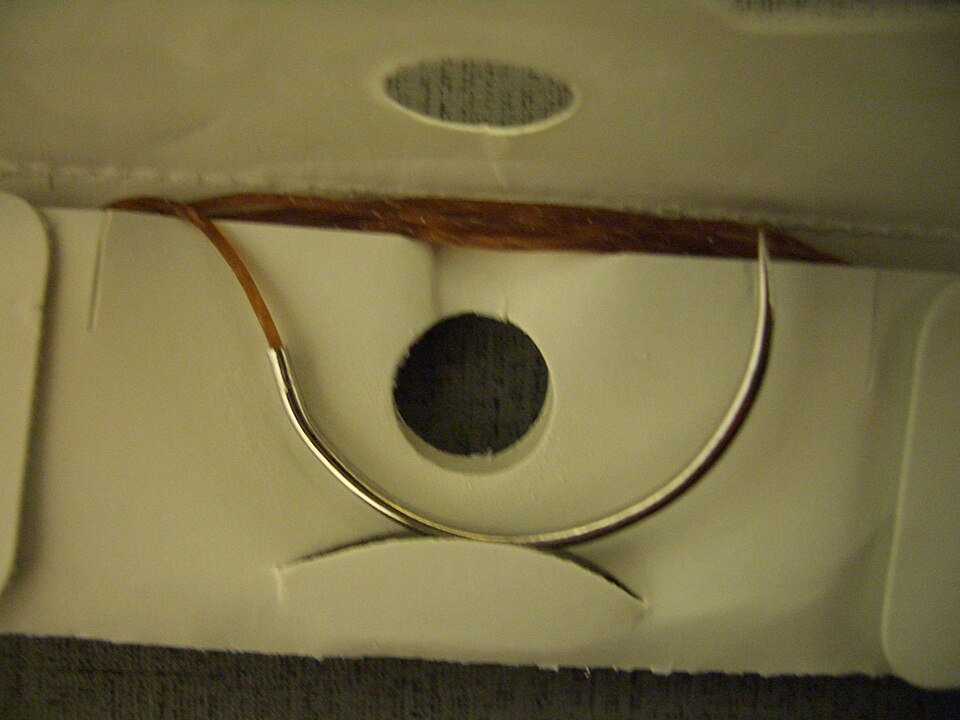
A surgical needle has three parts: the eye (or swage), the body and the point.3 On a swaged (eyeless) needle the suture is already attached to the end of the needle, so there is no need to match the needle eye to the strand size.3 The body is described by its curve as a fraction of a circle, commonly 3/8 or 1/2 circle.3
- Taper point: round body that pierces and spreads tissue without cutting it. It leaves a small hole. Used for gut, bladder, vessels and subcutaneous tissue.2
- Conventional cutting: triangular point with the third cutting edge on the inside (concave) curve, facing the incision. Under tension the suture can tear through toward the wound edge.4
- Reverse cutting: third cutting edge on the outside (convex) curve. The flat side of the hole faces the incision and resists tearing, so most surgeons now use it for skin.42
- Taper-cut: a cutting tip on a taper body, for tough tissue such as tendon or calcified tissue.3
A simple rule from a surgical training handout: when in doubt, choose the taper point for everything except skin.3
Procedure or technique
Reading and opening a suture packet
- Check the order: material, size, needle type and needle curve. Confirm with the surgeon if anything is unclear.
- Read the packet. It states whether the suture is absorbable or not, natural or synthetic, and braided or monofilament.3 It also shows the material, USP size, strand length, needle point and curve, lot number and expiry date.
- Check that the outer peel pack is intact and dry and the product is in date.
- As the circulating technician, peel the outer wrap back and present the inner packet so the scrubbed person takes it, or flip it onto the sterile field without reaching across.
- As the scrubbed technician, load the needle in the needle holder jaws, one-third to one-half of the way from the swage to the point, in the middle third of the needle.3 Gripping the point blunts it; gripping the swage can bend or break it.
- Add every needle to the count. If a needle punctures a glove, discard the needle and change the glove.3
- Pass scissors to cut suture, not tissue scissors. Cut ends close to the knot, about 3 mm (gut is left longer, about 6 mm), to limit tissue reaction and foreign material in the wound.3
Flowchart: select suture for this tissue
The tree follows published selection principles: tissues that heal slowly, such as fascia and tendon, get non-absorbable suture or an absorbable with extended support of up to 6 months; fast-healing stomach, colon and bladder may be closed with absorbable suture; contaminated tissue gets monofilament; skin gets small inert monofilaments.3 Non-absorbable material in the urinary tract can act as a nidus for stone formation.3 Some surgeons prefer polydioxanone in the bladder because infected urine speeds up breakdown of faster sutures.2
Staples and tissue adhesive
| Option | Strengths | Limits | Technician role |
|---|---|---|---|
| Non-absorbable skin sutures | Cheap, adaptable to any wound shape | Need removal, usually 10 to 14 days | Remove, cutting next to the skin |
| Buried absorbable intradermal suture | No external stitches, no removal, no stitch marks | Temporary nodules can form under the scar | Stock the right absorbable |
| Skin staples | Much faster closure; safe in canine mastectomy | Slightly higher cost; pinch on removal | Remove with a staple remover |
| Cyanoacrylate tissue adhesive | Quick, holds closely apposed edges | Only for skin edges held in close apposition | Apply only to apposed edges if asked |
Source: Perret-Gentil3; Moreno et al. 20256; University of Minnesota Large Animal Surgery notes7; Merck Veterinary Manual5.
In a study of 50 female dogs having mastectomy, skin closure with staples was 9.8 times faster than with nylon, and the staple group had fewer wound complications.6 Cyanoacrylate glues are tissue adhesives used for minor wounds and widely for skin closure in exotic pets.9 A topical skin adhesive can be used to hold skin edges in close apposition.3 A grossly contaminated or infected wound may not be suitable for primary closure at all and may be managed open first.5
Species differences
- Dogs and cats: skin is thin, so fine sizes are used. Cats and small dogs need smaller suture and needles than large dogs, following the smallest-strong-enough rule.3
- Cattle: skin is very thick, like leather, and is often closed with size 1 to 3 suture. Cutting needles are needed for skin in all species.7
- Horses, pigs, sheep and goats: skin is closer to dog and cat thickness and can be closed with 2-0 to 3-0.7
- Staples in large animals: used in non-bovine patients, but they pinch on removal, so they suit emergencies or cases where removal will not injure the person removing them.7
- Exotics: cyanoacrylate is widely used for skin closure and for repair of bird beaks and chelonian shells.9
Calculation
Worked example: booking a suture removal. A dog has a skin laceration closed with nylon on March 3. Skin sutures are usually removed 10 to 14 days after surgery.3
Earliest date: March 3 + 10 days = March 13.
Latest date: March 3 + 14 days = March 17.
Book the recheck between March 13 and March 17, and tell the owner the veterinarian may change this if healing is slow or the wound is over a joint.
Safety, legal and client education
- Needles and scalpel blades are sharps. Count them in and out, and dispose of them in a sharps container.
- Never use expired or damaged packets on the sterile field.
- When removing skin sutures, clean the site, lift one end of the suture, cut as close to the skin as possible where the strand enters the skin, and gently pull the strand out through the side opposite the knot, so no part that was outside the skin is pulled back through it.3
- Tell owners which closure their pet has: buried absorbable suture needs no removal; external sutures and staples need a recheck. Stitches tied too tight or left too long can leave "hatch marks" beside the scar.3
- Small firm lumps under an intradermal closure a couple of weeks later can be the absorbable suture breaking down; they tend to fade over months.3 Owners should still report swelling, discharge or gaping.
Common mistakes and exam traps
- Reading size backwards: 4-0 is thinner than 2-0. More zeros means finer.
- Calling all monofilaments absorbable: nylon and polypropylene are monofilament and non-absorbable; polydioxanone is monofilament and absorbable.
- Confusing cutting types: reverse cutting has the third edge on the outer curve, not the inner.
- Braided suture in a contaminated wound: capillarity wicks bacteria; choose monofilament.
- Silk for skin: high tissue reactivity; not used for skin closure.
- Absorption time equals strength: polyglactin 910 loses half its strength in 2 to 3 weeks, long before it is absorbed.
Quick review
- Three descriptors: absorbable or not, natural or synthetic, mono or multifilament.
- Synthetic absorbables break down by hydrolysis; natural ones by proteolysis.
- Poliglecaprone 25: 50% strength at 1 to 2 weeks; absorbed about 119 days.
- Polyglactin 910: 50% at 2 to 3 weeks; absorbed 56 to 70 days; braided.
- Polydioxanone: 50% at 5 to 6 weeks; absorbed about 180 days; monofilament.
- Nylon and polypropylene: non-absorbable monofilaments for skin.
- More zeros, finer suture; use the smallest size strong enough.
- Taper point for soft, easily penetrated tissue; reverse cutting for skin.
- Swaged needles have the strand already attached.
- Grip the needle in its middle third, away from point and swage.
- Skin sutures are usually out at 10 to 14 days.
- Staples are faster; cyanoacrylate suits closely apposed, clean edges.