Introduction
A blood transfusion replaces red blood cells (RBCs), clotting factors, platelets or protein that a patient cannot make or has lost. It can save a life, but it is also a tissue transplant, and the wrong unit can destroy itself inside the patient within hours.6
The technician usually types the patient, sets up the crossmatch, prepares the product, runs the line and takes the vital signs every 15 minutes. This guide covers canine and feline blood groups, typing and crossmatching, donor selection and collection, blood components and storage, administration, and how to recognize and respond to a transfusion reaction.
Key facts
- Dog erythrocyte antigen (DEA) 1 is the most clinically relevant canine blood type. Cats are grouped by the AB system into type A, B or the rare AB.2
- Cats have strong naturally occurring alloantibodies against the blood type they lack, so AB typing is essential before every feline transfusion.12
- A major crossmatch mixes donor RBCs with recipient serum or plasma. It is recommended in dogs more than 4 days after any transfusion and in cats regardless of transfusion history.51
- RBC products are stored at 2 to 6 degrees C for 21 to 42 days. Fresh frozen plasma (FFP) is stored at minus 20 degrees C for up to 1 year.4
- Blood runs in a dedicated IV line with an in-line blood filter, by gravity or on a pump approved for blood. Calcium-containing fluids and medications never go in the same line.1
- Vital signs are checked every 15 minutes for the first hour, then hourly, then 15 minutes, 1 hour and 24 hours after the transfusion ends.1
- Fever is one of the most common signs of a transfusion reaction. A suspected acute hemolytic reaction means stop the transfusion now.1
How the VTNE tests this
- Choose the right product or blood type for a dog or cat, and explain why a type B cat cannot receive type A blood (Domain 8 Task D, blood component therapy).9
- Set up and read a blood typing card or a major and minor crossmatch (Domain 4 Task C, laboratory tests including hematology and serology; K25).9
- Calculate a packed RBC volume or a test dose from body weight and PCV.
- Recognize a transfusion reaction from the monitoring sheet and pick the first action (Domain 8 Task D and E; K35, emergency and critical care techniques).9
- Store, thaw and handle blood components correctly.
Core concepts
Blood groups and alloantibodies
A blood type is set by inherited antigens on the RBC surface. An alloantibody is an antibody against a blood group antigen from another animal of the same species. Exposure to foreign RBC antigens, for example through a transfusion, can cause dogs and cats to make alloantibodies. Cats also carry strong naturally occurring alloantibodies (NOAbs) without any prior exposure.2
Dogs: DEA 1 and others
Recognized canine groups include DEA 1, 3, 4, 5, 6, 7 and 8. The old subtypes DEA 1.1, 1.2 and 1.3 are now explained as different amounts of one antigen, so DEA 1 is reported as negative, weak positive, or 2+ to 4+ positive. About 33 to 65% of dogs are DEA 1 positive, depending on the area.2
Dogs do not carry clinically important natural antibodies against DEA 1. A DEA 1-negative dog given DEA 1-positive blood can become sensitized, and a later DEA 1-positive transfusion can then cause a hemolytic reaction.26 A DEA 1-positive dog can safely receive DEA 1-negative RBCs, but giving positive blood to positive dogs saves the scarce negative units. A weak positive donor is treated as positive. A weak positive recipient should receive DEA 1-negative blood.1
The Dal antigen is present in most dogs. Dal-negative dogs are seen more often in Doberman Pinschers, Dalmatians and Shih Tzus. A Dal-negative dog exposed to Dal-positive cells becomes sensitized and can react on a repeat transfusion.2
Cats: the AB system
Most cats are type A. Type B frequency varies by region and breed, and type AB is rare.2 In the USA, 94 to 99% of domestic shorthair and longhair cats are type A. Breeds with 20 to 45% type B include British Shorthair, Exotic Shorthair, Cornish Rex and Devon Rex.6
Type B cats carry strong anti-A antibodies. Type A blood given to a type B cat is destroyed fast (mean half-life 1.3 hours), with hypotension, vomiting, hemoglobinemia, depression and even death. Type B blood given to a type A cat causes milder signs, but the cells survive only about 2.1 days. Type AB cats lack NOAbs and can receive type A or B blood.6 Cats also have antigens outside the AB system, such as Mik and the feline erythrocyte antigens FEA 1 to 5, and can carry NOAbs against them.2 In one study, 14% of never-transfused cats had an incompatible crossmatch for this reason.6
Blood typing
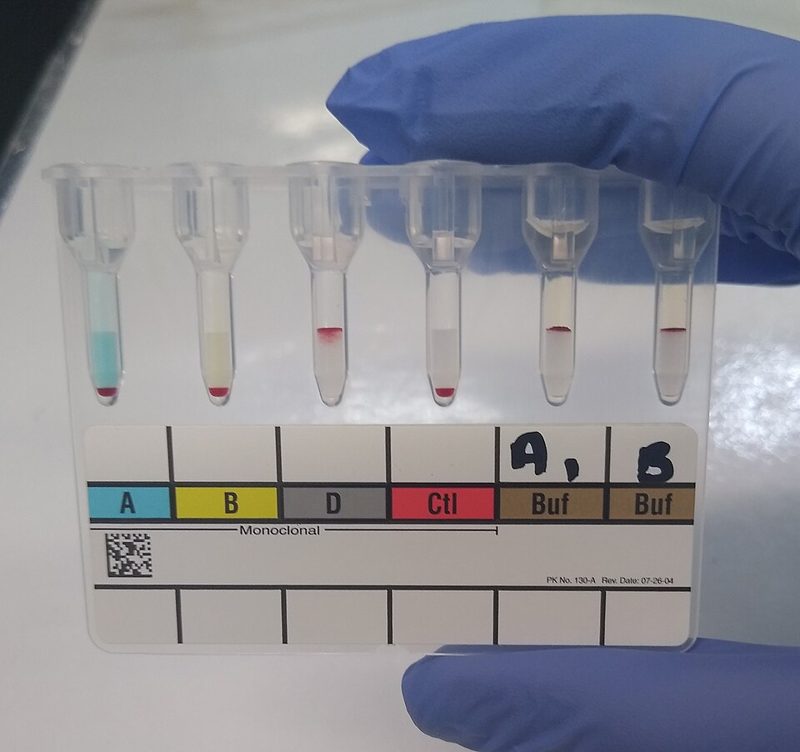
In-clinic typing kits use monoclonal antibodies. On a card test, dried antibody in the patient well makes the blood clump (agglutinate) if the antigen is present. Cards exist for canine DEA 1, 4, 5 and Dal, and for feline AB. Immunochromatographic strip kits detect canine DEA 1, including weak expression, and feline A and B.3 Always read the control wells first. The saline (autoagglutination) well should not clump, and the positive control should.3 If the saline well clumps, the patient's own cells are agglutinating and the card cannot be read.
Crossmatching
A crossmatch tests one donor against one recipient. It finds incompatibilities that typing misses, because typing covers only the major antigens.5
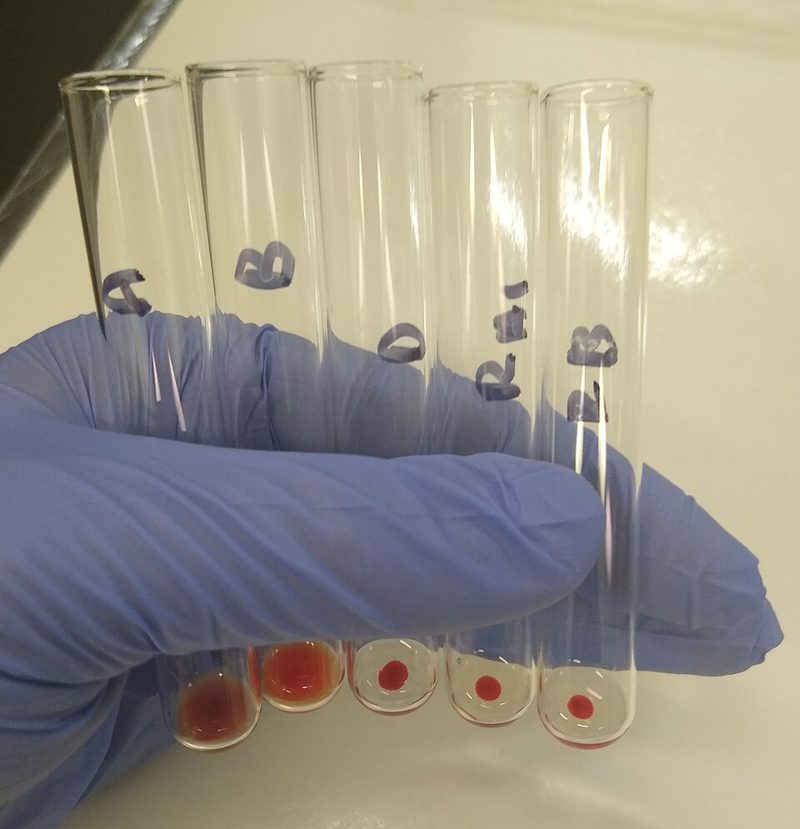
- Major crossmatch: donor RBCs plus recipient serum. It looks for antibodies in the recipient against the donor's cells, and it is the most important one. You need donor RBCs (in EDTA or citrate) and recipient serum from a plain tube.5
- Minor crossmatch: donor serum plus recipient RBCs. It is less important, because donor plasma is diluted in the recipient, but it can matter in very small patients.5
In the classic tube method, the RBCs are washed, incubated with the serum (usually at 37 degrees C), and checked by eye and under the microscope for agglutination, and for hemolysis in horses and ruminants. Gel and strip kits are now more common.5 A strong incompatible major crossmatch means that unit must not be given. With an incompatible minor crossmatch, the transfusion can go ahead, but packed cells with the donor plasma removed are preferred if the plasma would be a large share of the recipient's volume.5 A compatible crossmatch does not detect low antibody levels and will not prevent a delayed hemolytic reaction.5
Blood components
Donor blood can be given as whole blood or split into packed RBCs (pRBC), plasma and platelet products. Component therapy replaces only what the patient needs, which lowers reaction risk and stretches the blood supply.4 The decision to give RBCs rests on clinical signs (weakness, tachycardia, tachypnea, hypotension, high lactate), not on a single hematocrit cutoff.4
| Component | Main use | Storage and handling |
|---|---|---|
| Whole blood | Blood loss (hemorrhage) | Whole blood stored at room temperature for up to 8 hours is also a (less concentrated) platelet source |
| Packed RBCs | Anemia from hemolysis or poor RBC production, when plasma is not needed | 2 to 6 degrees C for 21 to 42 days; stays in the fridge until just before use |
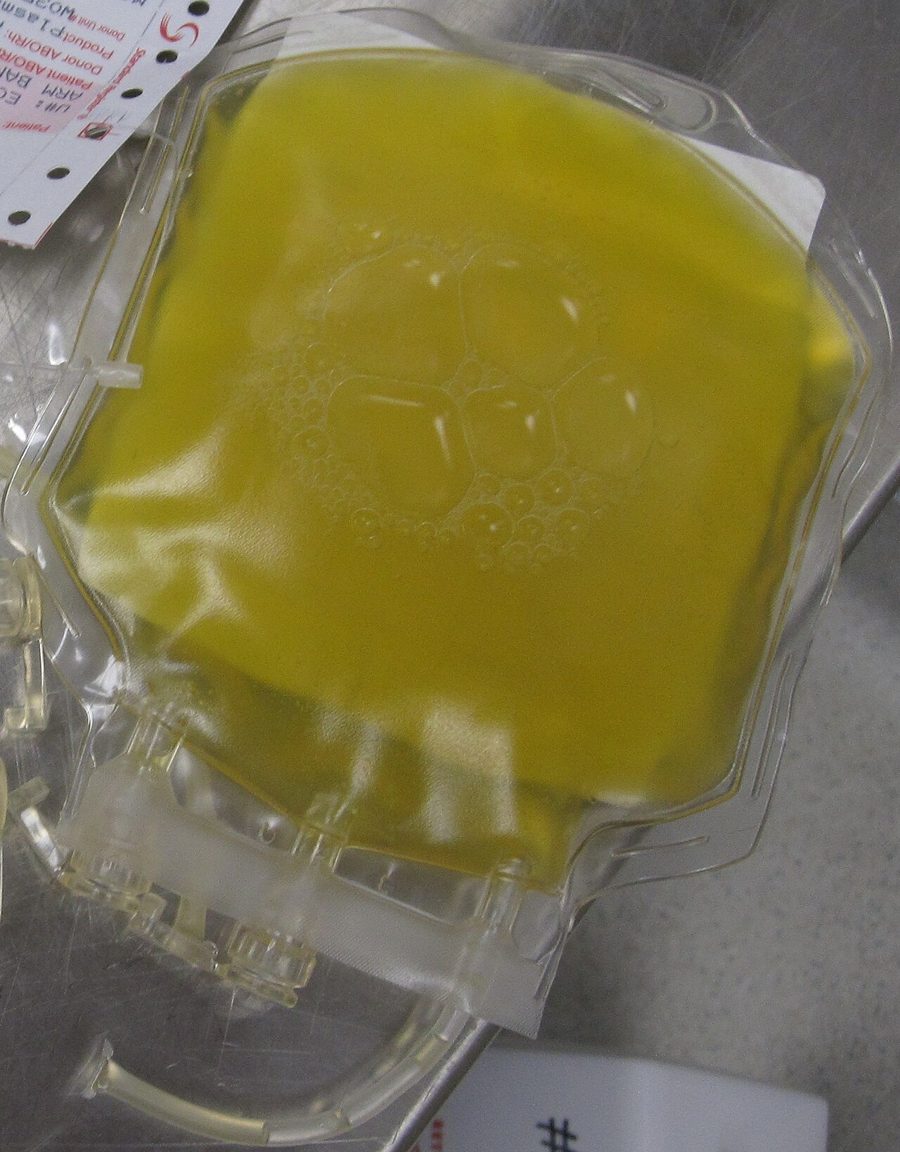
| Fresh frozen plasma | Bleeding from coagulopathy; colloid support. Contains all clotting factors, von Willebrand factor, albumin and immunoglobulins | Minus 20 degrees C for up to 1 year; thaw just before use |
| Frozen plasma | As FFP, but lacks labile factors V and VIII | FFP stored longer than 1 year |
| Cryoprecipitate | Concentrated fibrinogen, von Willebrand factor, factor VIII and factor XIII | Frozen plasma product; thaw just before use |
| Platelet products | Uncontrolled or life-threatening bleeding from low or poorly working platelets | Dose 1 unit per 10 kg, given within 2 hours |
| Canine albumin (lyophilized) | Hypovolemic shock and low albumin; plasma is a poor albumin source | Reconstituted just before use |
Source: Merck Veterinary Manual, Screening of Blood Donors and Blood Banking and Blood Transfusions in Dogs and Cats.41
Procedure or technique
Donor selection and collection
Donors must be healthy and test negative for the blood-borne infections relevant to the region, including vector-borne diseases in dogs and retroviruses in cats.4 As one example, a European blood bank program used dogs of 20 to 60 kg and indoor cats of 3.5 to 9 kg, aged 1 to 10 years, vaccinated and dewormed. Dogs were screened for Anaplasma, Ehrlichia, Babesia, Leishmania, Brucella and heartworm. Cats were screened for FIV, FeLV and hemotropic Mycoplasma.8 A large UK feline program required a calm cat over 3.0 kg, 1 to 10 years old, on no medication and never transfused, and collected 10 mL/kg as standard (maximum about 13 mL/kg).7
- Confirm the donor's screening, blood type and a normal physical exam on the day.
- Clip and aseptically prepare the jugular site. Blood is collected aseptically into bags containing anticoagulant.4
- Dogs: blood flows by gravity into a bag holding about 450 mL of blood with 63 mL of CPD (citrate phosphate dextrose) anticoagulant; one program collected about 11 to 13 mL/kg.8
- Cats: a syringe-based semi-closed system with CPD anticoagulant is used, and some donors need sedation based on temperament.7
- Label the unit, then store or process it into components.
Giving a transfusion: the technician's steps
- Confirm the order, the patient's blood type and, when needed, a compatible crossmatch. Check the unit label and expiry against the patient.
- Keep RBCs in the refrigerator until just before use. Thaw frozen plasma just before use.1
- Record baseline temperature, pulse, respiration, mucous membrane color, attitude and PCV/TP.
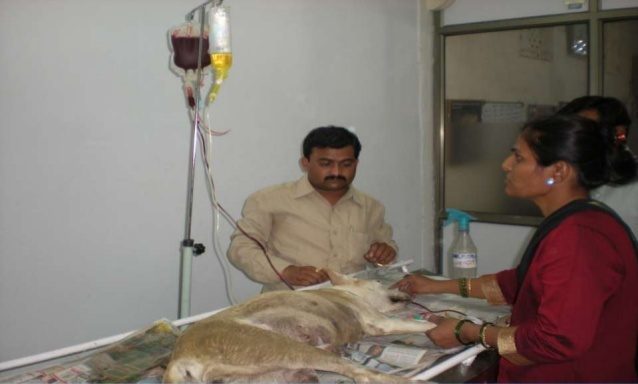
- Use a dedicated IV line with an in-line blood filter. Give by gravity or with a pump approved for blood products. Small feline volumes can run through a syringe pump with an 18-micron microaggregate filter.1
- Never add calcium-containing fluids (such as lactated Ringer's) or medications to the blood line.1
- If the patient is stable, give a test dose as ordered, for example 0.25 mL/kg over 15 minutes, and watch closely before going to the full rate.1
- Run at the ordered rate. Unstable patients may get blood quickly. Stable patients usually receive it over 4 hours, and patients with heart or kidney disease more slowly.1
- Take vital signs every 15 minutes for the first hour, then hourly, then 15 minutes, 1 hour and 24 hours after the end. Check PCV after an RBC transfusion to judge effect.1
See figure: Blood product filter, cat (Merck Veterinary Manual, courtesy of Dr. Shauna Blois), showing an 18-micron microaggregate filter on a syringe pump line.
Recognizing transfusion reactions
| Reaction | Signs and timing | Action |
|---|---|---|
| Febrile nonhemolytic reaction | Temperature above 39 degrees C (102.2 F) and a rise over 1 degree C (1.8 F) during or within 4 hours, no other cause | Report; full patient check because severe reactions can also start with fever. Mild and self-limiting |
| Acute hemolytic reaction | Fever, tachycardia, dyspnea, up to hypotension, shock and DIC; hemoglobinemia; PCV fails to rise | Stop the transfusion; vet starts fluids and supportive care |
| Delayed hemolytic reaction | Often only a faster PCV drop more than 24 hours later | Report falling PCV |
| Circulatory overload (TACO) | New respiratory distress, tachypnea or cough during or within 24 hours | Stop the transfusion; vet may give a diuretic |
| Allergic reaction | Dogs: hives, swelling, vomiting. Cats: mainly breathing difficulty | Pause and report; antihistamine for mild cases, epinephrine for anaphylaxis |
| Bacterial contamination | Vomiting, fever, shock | Stop; save the bag; culture the product and the patient's blood |
Source: Merck Veterinary Manual, Blood Transfusions in Dogs and Cats, Risks of Blood Transfusion.1
Flowchart
Figure 7 is the decision path when a patient changes during a transfusion. The technician pauses, measures and reports. The veterinarian decides whether to restart.
Species differences
- Dog: no clinically important natural antibodies against DEA 1, so a first transfusion is lower risk, but it sensitizes the dog. Type for DEA 1 before every transfusion and crossmatch if the dog was transfused more than 4 days before.1 eClinPath gives an interval of more than 5 days.5
- Cat: natural anti-A and anti-B antibodies mean even a first mismatched transfusion can kill. Type every cat and crossmatch as well, because of non-AB antigens.16 Allergic reactions in cats are mainly respiratory.1 Canine blood given to a cat (xenotransfusion) survives only briefly and is used only when no feline option exists.1
- Kittens: a type B queen's colostrum holds anti-A antibodies. Type A or AB kittens that nurse in the first 24 hours can develop neonatal isoerythrolysis, a hemolytic anemia, so they are fed another way and returned to the queen after 24 hours.1
- Horse: there is no equine universal donor. Ideal donors are large, quiet geldings or maiden mares with a PCV above 35%, negative for Aa and Qa antigens and antibodies. Horses have few natural antibodies, so an urgent first transfusion can usually go ahead without a crossmatch.10
Calculation
Worked example: packed RBC volume. A 20 kg dog has a PCV of 15%. The veterinarian wants a PCV of 25%. The pRBC unit has a PCV of 60%. Use 90 mL/kg for canine blood volume (Merck gives 80 to 90 mL/kg for dogs and 40 to 60 mL/kg for cats).1
Formula: volume (mL) = ((desired PCV minus recipient PCV) / unit PCV) x blood volume (mL/kg) x body weight (kg).1
Step 1: (25 minus 15) / 60 = 10 / 60 = 0.167 (the % units cancel).
Step 2: 0.167 x 90 mL/kg x 20 kg = 300 mL (kg cancels, leaving mL).
Test dose: 0.25 mL/kg x 20 kg = 5 mL over the first 15 minutes, which is a rate of 20 mL/h.
Safety, legal and client education
- Check the unit label, blood type and expiry against the patient before spiking, and record the unit number in the record.
- Pathogen screening protects the recipient. Explain to donor owners that their pet is tested for regional infections before it can donate.4
- Advise breeders of high type B cat breeds to type queens and toms to prevent neonatal isoerythrolysis. Genotyping can identify B/B breeding pairs.1
- If xenotransfusion is considered, the veterinarian discusses the risks with the client first.1
- If bacterial contamination is suspected, keep the bag and line so the product and the patient's blood can be cultured.1
Common mistakes and exam traps
- Mixing up the major and minor crossmatch. Major is donor cells with recipient serum.
- Calling DEA 1-negative dogs "universal donors" and skipping the crossmatch in a dog transfused weeks ago. A sensitized dog needs a crossmatch.
- Thinking a cat can get a first transfusion untyped. Cats have natural antibodies, and type B cats die from type A blood.
- Running blood with lactated Ringer's or with drugs in the same line. Calcium-containing fluids and medications stay out of the blood line.
- Using the old DEA 1.1 names on current questions. DEA 1 is now reported as negative, weak positive or positive.
- Treating fever as harmless without a full check. Fever is common in mild reactions but can also be the first sign of a severe one.
Memory aids
MAJOR = Me Against Juice Of Recipient: the major crossmatch puts the donor's cells (me) into the recipient's serum (memory aid).
B is for Bad: type B cats carry strong anti-A antibodies, so type A blood into a type B cat is the deadly mismatch (memory aid).
15, 60, 24: vitals every 15 minutes in the first hour, then hourly, then 15 minutes, 1 hour and 24 hours after the end (memory aid).
No calcium, no cocktails: no calcium-containing fluids and no drugs in the blood line (memory aid).
Cold cells, frozen plasma: RBCs at 2 to 6 degrees C, FFP at minus 20 degrees C for up to 1 year (memory aid).
Quick review
- DEA 1 is the key canine blood type; about 33 to 65% of dogs are positive.
- Cats are type A, B or rare AB, with strong natural antibodies.
- Type A blood into a type B cat is destroyed within hours and can kill.
- Type AB cats can receive type A or type B blood.
- Read the saline and positive control wells before the patient well.
- Major crossmatch: donor RBCs plus recipient serum.
- Crossmatch dogs transfused more than 4 days ago, and crossmatch cats every time.
- RBCs: 2 to 6 degrees C for 21 to 42 days. FFP: minus 20 degrees C for up to 1 year.
- Dedicated line, blood filter, no calcium fluids, no drugs.
- Test dose such as 0.25 mL/kg over 15 minutes in stable patients.
- Vitals every 15 minutes for the first hour, then hourly.
- Hemolysis or breathing distress: stop the transfusion and keep the line open.