Introduction
Anesthesia runs on numbers. Before the first injection, the technician turns a dose in mg/kg into a volume in a syringe. Once the patient is connected to the machine, the technician sets an oxygen flow that suits the breathing system, picks a reservoir bag and an endotracheal tube (ETT) of the right size, and often prepares a constant rate infusion (CRI), a drug given at a steady rate by fluid bag or syringe pump.
This guide collects those calculations in one place. Each formula comes with a worked example, the usual exam traps and a decision tree for choosing the right flow formula. The veterinarian chooses the drug and the dose. The technician's job is to turn that order into an accurate volume, rate or setting, and to check it twice.
Key facts
- Dose (mg) = weight (kg) x dosage (mg/kg). Volume (mL) = dose (mg) / concentration (mg/mL).6
- Non-rebreathing circuit (NRC) oxygen flow: about 200 to 400 mL/kg/min.1
- Rebreathing (circle) maintenance flow: 20 to 40 mL/kg/min, with a minimum of 500 mL/min.1
- NRCs are commonly used for patients under about 3 to 5 kg; circle systems above that.1
- Average tidal volume in a normal awake patient is 10 to 15 mL/kg.4 Minute volume = tidal volume x respiratory rate.
- Equipment dead space should be kept at or below 2 to 3 mL/kg, about 20% of tidal volume.1
- Lidocaine 2% contains 20 mg/mL; 1% contains 10 mg/mL.8
- A CRI needs five numbers: weight, dosage, fluid volume, fluid rate and drug concentration.6
How the VTNE tests this
Anesthesia is 20 of the 150 scored VTNE items (13%). Task B of the anesthesia domain asks you to "assist in the development and implementation of an anesthetic plan to ensure patient safety and procedural efficacy". Knowledge statement 7 is applied mathematics, "including but not limited to metric system/weights, measures/percentage solutions, dosage calculations".10 Expect items such as:
- How many mL of a premedicant to draw up for a patient of a given weight.
- The oxygen flow rate for a given circuit and weight, including the circle minimum.
- Tidal volume or minute volume for a ventilated patient.
- A pump rate in mL/h for a CRI ordered in mcg/kg/min or mg/kg/h, or the amount of drug to add to a fluid bag.
Core concepts
Units first
Most errors start with units, not arithmetic. Convert the weight to kilograms before you begin. Convert micrograms to milligrams (1 mg = 1,000 mcg) so the dose and the concentration share a unit. Convert per minute to per hour (x 60) when a pump runs in mL/h. Write the unit beside every number; if the units do not cancel to the answer you want, the setup is wrong.
Percent solutions are weight per volume: grams per 100 mL. Mages notes that most drugs in veterinary practice are labeled this way.6 A 2% solution holds 2 g in 100 mL, which is 20 mg/mL. The lidocaine label shows the same thing: 1% (10 mg/mL) and 2% (20 mg/mL).8
Oxygen flow depends on the circuit
An NRC has no CO2 absorbent. It depends on a high fresh gas flow to push exhaled CO2 away from the patient, so the flow is high per kilogram: about 200 to 400 mL/kg/min.12 Lee expresses NRC flow as a multiple of minute volume: about 1 to 1.5 times minute volume (about 150 mL/kg/min) for Magill and Lack systems, and about 2.5 times minute volume (about 250 mL/kg/min) for the Bain and T-piece.3
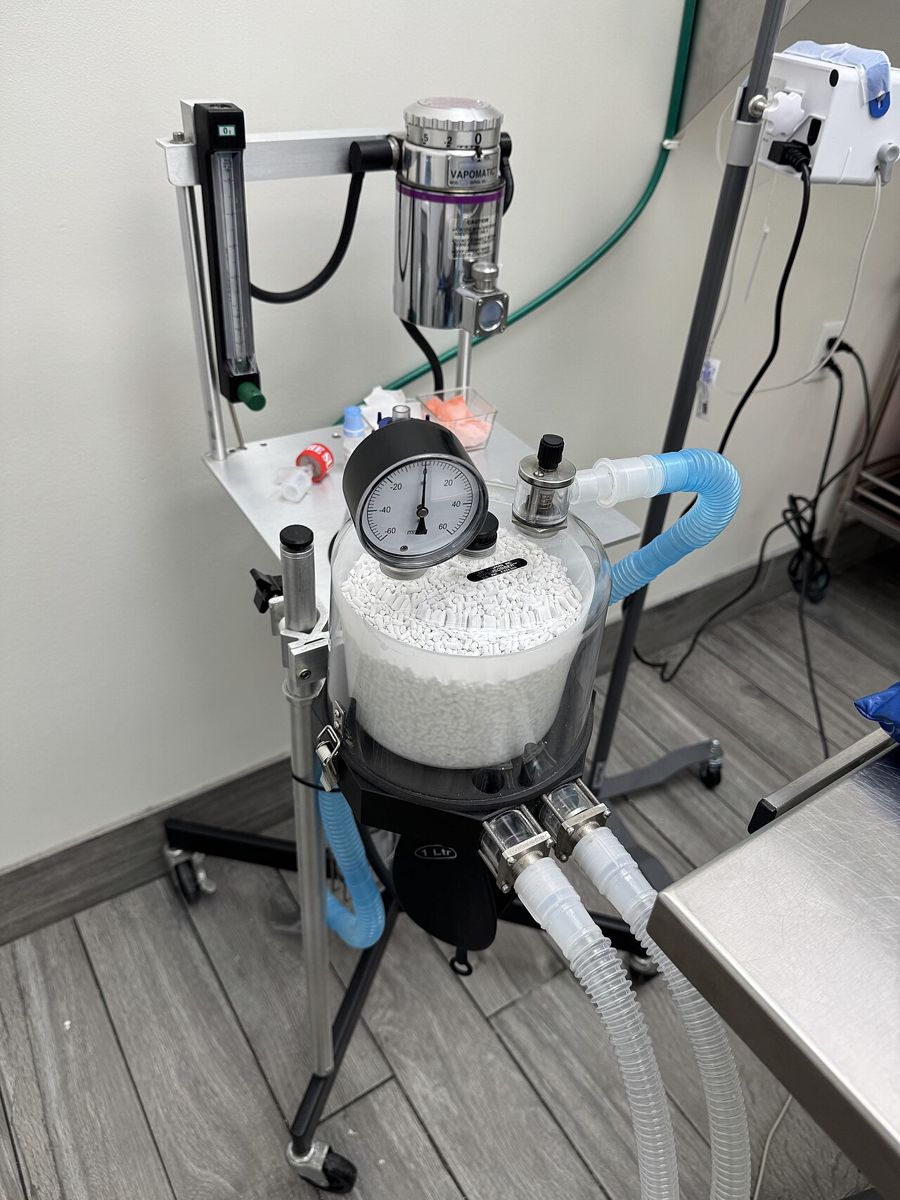
A circle system removes CO2 with absorbent and lets the patient rebreathe the rest of the gas, so it needs far less. AAHA gives 20 to 40 mL/kg/min for maintenance, with a minimum of 500 mL/min.1 Lee labels 10 to 20 mL/kg/min "low flow", 20 to 40 mL/kg/min "medium flow" (suitable for most clinical cases) and more than 40 mL/kg/min "high flow".3 Higher flows at the start of a case change the inhalant concentration in the circuit faster; AAFP lists 2 to 3 L/min for the first 15 minutes in cats on a circle, then a maintenance minimum of 0.5 L/min.2
Tidal volume, minute volume and dead space
Tidal volume is the volume of one breath. VASG gives 10 to 15 mL/kg for a normal awake patient and notes that tidal volume falls during anesthesia.4 Minute volume is the volume breathed in one minute: tidal volume x breaths per minute. Equipment dead space is the part of the circuit where inspired and expired gas mix, mostly at the patient end. AAHA advises keeping it at or below 2 to 3 mL/kg, about 20% of tidal volume.1 That is why a large elbow adapter or capnograph adapter matters more in a 2 kg kitten than in a 40 kg dog.
Reservoir bag size
The bag must hold more than one deep breath, yet be small enough to show each breath as it moves. Lee lists bags of 0.5, 1, 2, 3 and 5 L for small animals, with 0.5 L for cats and small dogs and 2 L typical for a 20 kg dog. A bag that is too large is hard to use as a breathing monitor.3 AAFP lists a 1 L bag for cats from 3 to 10 kg on a circle.2 When a weight falls between sizes, choose the next bag up that still moves visibly with each breath.
Endotracheal tube size
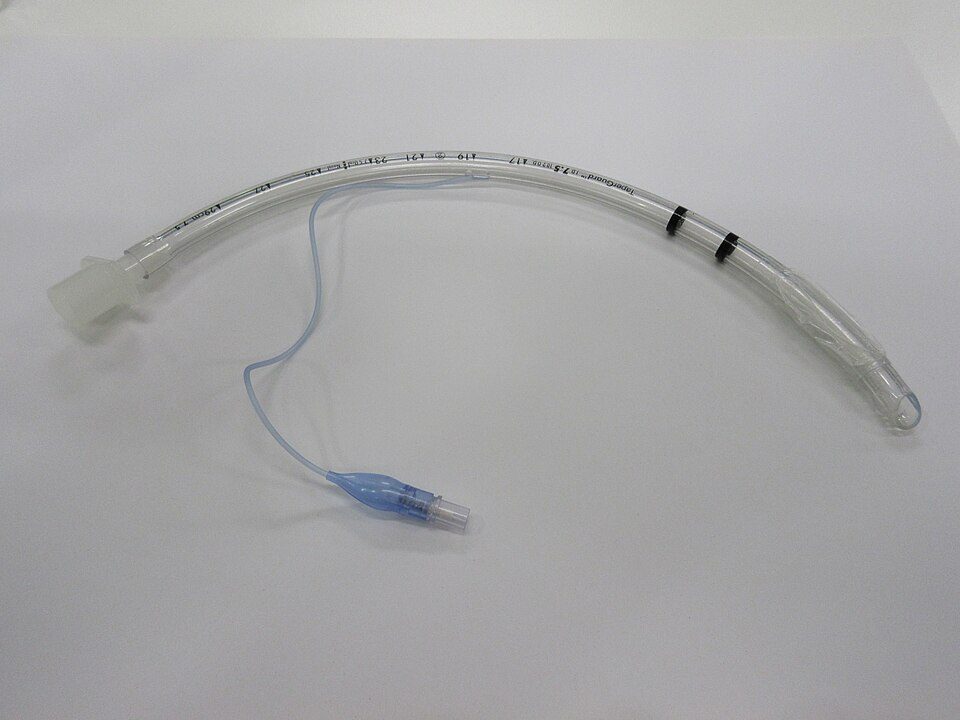
Body weight gives only a starting point. Most adult cats need a 3.5 to 5.0 mm internal diameter tube, and AAFP advises having 2.0 to 5.5 mm tubes ready.2 In dogs, Kim and colleagues found that tracheal diameter varied among breeds even within a narrow weight range, and that brachycephalic dogs were usually intubated with smaller tubes than weight predicted.5 Lay out the estimated size plus one size above and one below.
| What you need | Formula | Watch for |
|---|---|---|
| Dose of drug | kg x mg/kg = mg | Weight in kg, not lb |
| Volume to draw up | mg / (mg/mL) = mL | mcg doses: convert to mg, or concentration to mcg/mL |
| Percent to mg/mL | % x 10 = mg/mL | 2% lidocaine = 20 mg/mL |
| NRC oxygen flow | kg x 200 to 400 mL/kg/min | Result in mL/min; divide by 1,000 for L/min |
| Circle maintenance flow | kg x 20 to 40 mL/kg/min | Never below 500 mL/min |
| Tidal volume | kg x 10 to 15 mL/kg | Falls under anesthesia |
| Minute volume | tidal volume x breaths/min | Answer in mL/min |
| CRI by syringe pump | kg x dose per min x 60 / concentration = mL/h | Same units for dose and concentration |
| CRI in a fluid bag | (kg x dose per h) x (bag mL / rate mL/h) / concentration = mL to add | Bag time in hours must match the dose rate |
Source: Mages, M3; AAHA 2020; Lee, Breathing circuits; VASG; Sandoz lidocaine label.61348
Procedure or technique
Setting up a CRI
Mages lists five pieces of information for every CRI: patient weight, dosage, fluid volume, fluid rate and drug concentration. The four steps are:6
- Solidify it (mg/h): weight x dosage.
- Time it (h): fluid volume / fluid rate, which tells you how many hours the bag will last.
- Get it (mg): mg/h x hours, the total drug the bag must hold.
- Give it (mL): total mg / concentration, the volume of drug to add.
For a syringe pump the drug often runs undiluted or in a small diluted syringe, so you need only steps 1 and 4: the drug per hour divided by the concentration gives the pump rate in mL/h. Mages advises double-checking every CRI calculation before you start it and keeping a reference sheet of common drugs and weights.6 Label the bag or syringe with the drug, the amount added, the final concentration, the date and time and your initials.
Setting oxygen flow
- Identify the circuit: NRC or circle.
- Multiply the weight by the per-kilogram flow for that circuit.
- For a circle, compare the answer with 500 mL/min and use the larger number.1
- Convert to L/min and set the flowmeter.
- Recheck when the plan changes, for example a higher flow at the start of a circle case.2
Flowchart: which flow formula?
Species differences
- Cats. AAFP recommends an NRC for cats under 3 kg; above that either circuit can be used. On a circle, cats from 3 to 10 kg use a 1 L bag, 2 to 3 L/min for the first 15 minutes and at least 0.5 L/min for maintenance.2 An average cat has about 400 mL of lung capacity, so high NRC flows and the flush valve put cats at real risk of lung injury from pressure.1
- Cats and drug doses. Doses differ by species. Dexmedetomidine for cats is labeled at 40 mcg/kg IM, and the product is supplied at 0.5 mg/mL.9 Merck lists lidocaine CRI doses for dogs; cats are more sensitive to the nervous system and heart effects of lidocaine.7
- Dogs. Breed changes tube size at the same weight, and brachycephalic dogs often need a smaller tube than weight predicts.5 A 20 kg dog typically uses a 2 L bag.3
- Large animals. Large-animal circles use bags of 15, 20 or 30 L.3
Calculation
Worked example 1: premedication volume
A 4 kg cat is to receive dexmedetomidine at the label dose of 40 mcg/kg IM. The vial is 0.5 mg/mL.9
Dose: 4 kg x 40 mcg/kg = 160 mcg = 0.16 mg
Volume: 0.16 mg / 0.5 mg/mL = 0.32 mL
Worked example 2: oxygen flow
A 3 kg cat on an NRC: 3 x 200 = 600 mL/min; 3 x 400 = 1,200 mL/min. Set 0.6 to 1.2 L/min.
A 10 kg dog on a circle at 20 mL/kg/min: 10 x 20 = 200 mL/min. That is below the 500 mL/min minimum, so set 0.5 L/min.1
Worked example 3: tidal and minute volume
A 20 kg dog: tidal volume 20 x 10 to 15 = 200 to 300 mL.4 At 12 breaths/min, minute volume is 2,400 to 3,600 mL/min (2.4 to 3.6 L/min).
Worked example 4: syringe pump CRI
The same 20 kg dog is ordered lidocaine 30 mcg/kg/min from undiluted 2% lidocaine (20 mg/mL) on a syringe pump.78
Drug per hour: 20 kg x 30 mcg/kg/min x 60 min/h = 36,000 mcg/h = 36 mg/h
Pump rate: 36 mg/h / 20 mg/mL = 1.8 mL/h
| Weight | NRC flow (200 to 400 mL/kg/min) | Circle maintenance (20 to 40 mL/kg/min) | Tidal volume (10 to 15 mL/kg) |
|---|---|---|---|
| 3 kg | 0.6 to 1.2 L/min | 60 to 120 mL/min, so set 500 mL/min | 30 to 45 mL |
| 10 kg | Not usually used | 200 to 400 mL/min, so set 500 mL/min | 100 to 150 mL |
| 20 kg | Not usually used | 400 to 800 mL/min, at least 500 mL/min | 200 to 300 mL |
| 40 kg | Not usually used | 0.8 to 1.6 L/min | 400 to 600 mL |
Source: calculated from AAHA 2020 flow guidance and VASG tidal volume.14
Safety, legal and client education
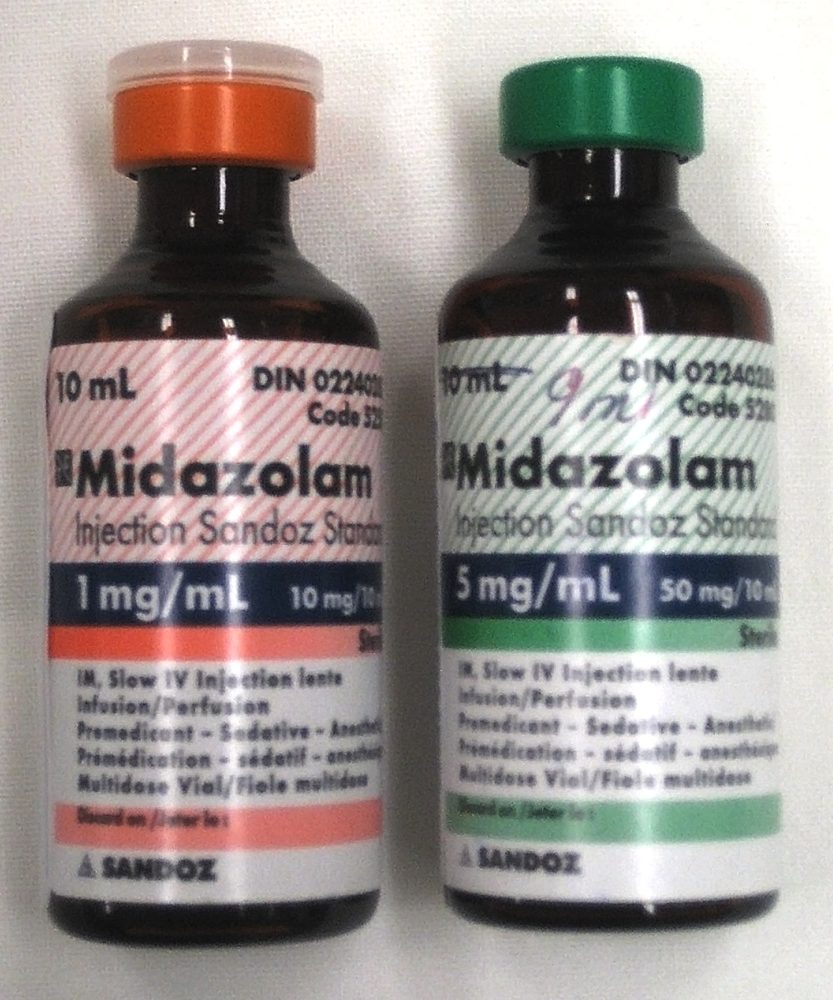
- Confirm the order, the weight in kg and the concentration on the vial before you draw up. Many drugs come in more than one strength (Figure 2).
- Double-check every CRI before it starts.6 Have a second person check the math where your hospital requires it.
- Label every bag and syringe that has drug added. Record the drug, total amount, final concentration and rate in the anesthetic record.
- Dexmedetomidine can be absorbed through skin, eyes or mouth. Wash skin exposures and flush eye exposures with water for 15 minutes.9
- Recheck the flowmeter whenever the patient changes circuits; an NRC relies on high oxygen flow to move exhaled CO2 away from the patient, so a circle-level flow on an NRC is too low.2
Common mistakes and exam traps
- Pounds in the formula. Divide by 2.2 first. A 22 lb dog is 10 kg, not 22 kg.
- mcg and mg mixed. 40 mcg/kg with a 0.5 mg/mL vial needs a conversion, or the answer is off by 1,000.
- Forgetting the circle minimum. Small dogs on a circle still get at least 500 mL/min.1
- Swapping circuit formulas. 200 to 400 mL/kg/min is NRC; 20 to 40 mL/kg/min is circle. A factor of ten separates them.
- Per minute vs per hour. A CRI in mcg/kg/min must be multiplied by 60 before you divide by concentration to get mL/h.
- Bag time. In the four-step method, the hours the bag lasts come from bag volume divided by fluid rate, not from the length of surgery.6
- Tube by weight alone. Weight is a first guess. Brachycephalic dogs often need smaller tubes.5
Memory aids
Solidify, Time, Get, Give: the four CRI steps from Mages: mg/h, hours the bag lasts, total mg, mL of drug to add.6
Dose then Divide (memory aid): kg x mg/kg gives the dose; divide by mg/mL to get the volume.
Percent times ten (memory aid): a percent solution x 10 gives mg/mL, so 2% lidocaine is 20 mg/mL.
Two-Four-Five for the circle (memory aid): 20 to 40 mL/kg/min, never below 500 mL/min.
Ten-fold for the NRC (memory aid): NRC flow is about ten times the circle flow, 200 to 400 mL/kg/min.
Ten to fifteen for tidal (memory aid): tidal volume is 10 to 15 mL/kg.
Quick review
- Dose (mg) = kg x mg/kg; volume (mL) = mg / (mg/mL).
- Percent x 10 = mg/mL; 2% lidocaine is 20 mg/mL.
- NRC flow: 200 to 400 mL/kg/min.
- Circle maintenance flow: 20 to 40 mL/kg/min, minimum 500 mL/min.
- Tidal volume: 10 to 15 mL/kg; minute volume = tidal volume x rate.
- Dead space at or below 2 to 3 mL/kg.
- Bags: 0.5 L for cats and small dogs, 1 L for 3 to 10 kg cats on a circle, 2 L for a 20 kg dog.
- Most adult cats take a 3.5 to 5.0 mm tube; dog tube size by weight is only a first guess.
- CRI: Solidify, Time, Get, Give. Syringe pump: mg/h / mg/mL = mL/h.