Introduction
Inhalant anesthetics are drugs breathed in through the lungs to keep a patient anesthetized. In small animal practice the two you will use most are isoflurane and sevoflurane. Inhalants give rapid control of anesthetic depth and a quick, smooth recovery, but they also depress the heart and blood vessels and can cause hypotension and bradycardia.3 The technician fills and sets the vaporizer, adjusts the dial on the veterinarian's plan, watches for the effects of each change and protects the team from waste gas. This guide covers potency (MAC), solubility, the precision vaporizer, nitrous oxide and waste anesthetic gas safety.
Key facts
- MAC (minimum alveolar concentration) is the alveolar concentration at which 50% of healthy patients fail to respond to a noxious stimulus. Surgical anesthesia usually needs 1.3 to 1.5 times MAC.1
- MAC is a measure of potency. The lower the MAC, the more potent the agent. In dogs the label MAC is 1.28% for isoflurane and 2.36% for sevoflurane.21
- The blood/gas partition coefficient measures solubility in blood. Sevoflurane (0.63 to 0.69) is less soluble than isoflurane (1.43), so induction, recovery and depth changes are faster.12
- Each agent must go in a precision vaporizer calibrated for that agent only.12
- Both agents cause dose-dependent hypotension and respiratory depression. The first response to excessive depression is to turn the vaporizer down.12
- Nitrous oxide is a weak adjunct, never a sole anesthetic. In one dog study 70% nitrous oxide lowered isoflurane MAC by 32%.6
- NIOSH recommends exposure limits of 2 ppm for a halogenated agent used alone, 0.5 ppm when combined with nitrous oxide, and 25 ppm for nitrous oxide alone.5
How the VTNE tests this
- Define MAC and use it to compare potency between agents (Domain 7 Task A; K42, K43).11
- Explain why a low blood/gas coefficient gives faster induction and recovery (Domain 7 Task A; K43).
- Recognize factors and drugs that lower inhalant requirements (Domain 7 Task B; K43).
- Set up, fill and maintain a precision vaporizer, and predict what happens when the wrong agent is used (Domain 7 Tasks C and D; K45).
- Choose the safest practice to reduce waste anesthetic gas exposure (Domain 7 Task C; K45).
Core concepts
MAC: how potent is the agent?
MAC is measured at the alveoli, which is why end-tidal agent concentration on a gas monitor is the closest bedside estimate. At 1 MAC, half of healthy animals still move in response to a painful stimulus. That is why the label states that surgical levels are typically 1.3 to 1.5 times MAC.1 A low MAC means a potent drug: less vapor is needed for the same effect. Isoflurane (MAC about 1.3% in dogs) is more potent than sevoflurane (about 2.3%), and desflurane (MAC 8 to 11%) is the least potent volatile agent.3
MAC values vary between studies and between individuals. One feline study cites a reported isoflurane MAC range in cats of 1.20% to 2.22%, with a mean of 1.71%.8 Treat published values as a starting point. Adjust to the patient's reflexes, blood pressure and breathing.
Solubility: how fast does it work?
The blood/gas partition coefficient tells you how much agent dissolves in blood before the brain reaches equilibrium. A low coefficient means little agent has to dissolve, so alveolar concentration rises quickly toward the inspired concentration.1 Sevoflurane's low solubility also lets the lungs remove it quickly at the end of anesthesia.1 Desflurane has the lowest coefficient of these agents and gives the quickest control of depth.3 Do not mix up the two ideas: MAC tells you potency, solubility tells you speed.
Effects the technician will see
Isoflurane is a profound respiratory depressant. As the dose rises, tidal volume and respiratory rate both fall, and blood pressure falls with each increase in depth.2 Isoflurane causes more peripheral vasodilation than halothane did, and sevoflurane causes cardiovascular depression to a similar degree as isoflurane.3 Because sevoflurane levels change quickly, its blood pressure and breathing effects can also appear quickly. Excessive decreases may be corrected by lowering or stopping the inspired concentration.1
| Property | Isoflurane | Sevoflurane | Desflurane | Nitrous oxide |
|---|---|---|---|---|
| MAC, dog | 1.28% (label); about 1.3% | 2.36% (label); about 2.3% | 8 to 11% | 188% to 222% (cannot reach MAC alone) |
| Blood/gas coefficient | 1.43 | 0.63 to 0.69 | Lowest of the volatile agents | Not covered here |
| Vapor pressure at 20 C | 238 mm Hg | 157 mm Hg | Needs an electronically controlled vaporizer | Gas from a cylinder |
| Boiling point | 48.5 C | 58.6 C | Not covered here | Not covered here |
| Main points for the technician | Mildly pungent, musty odor; profound respiratory depressant | Faster induction and recovery; check absorbent; mask induction up to 7% in healthy dogs | Expensive; quickest depth control | Adjunct only; reduces volatile agent needed |
Sources: SevoFlo and Isospire labels on DailyMed;12 Lee, Western University lecture notes;3 nitrous oxide MAC from a canine study.6
The precision vaporizer
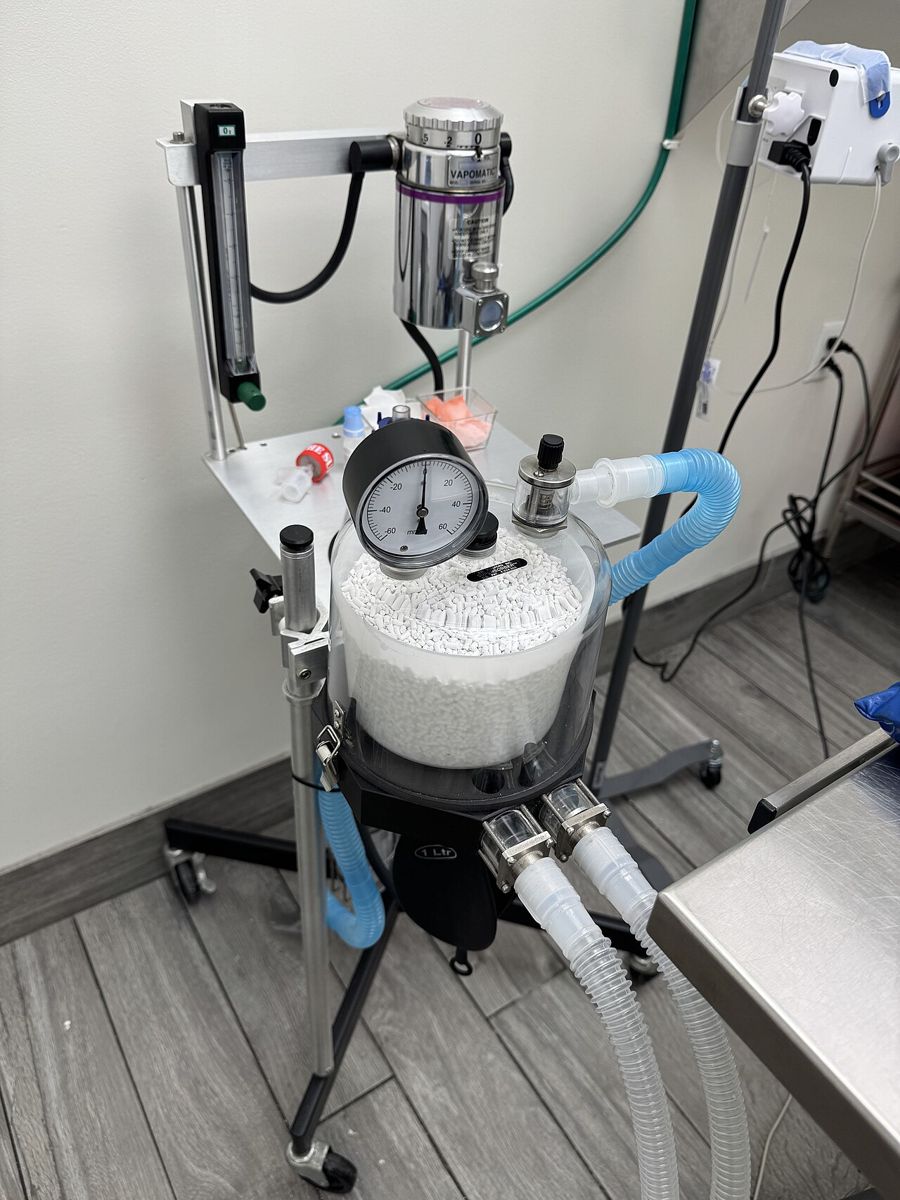
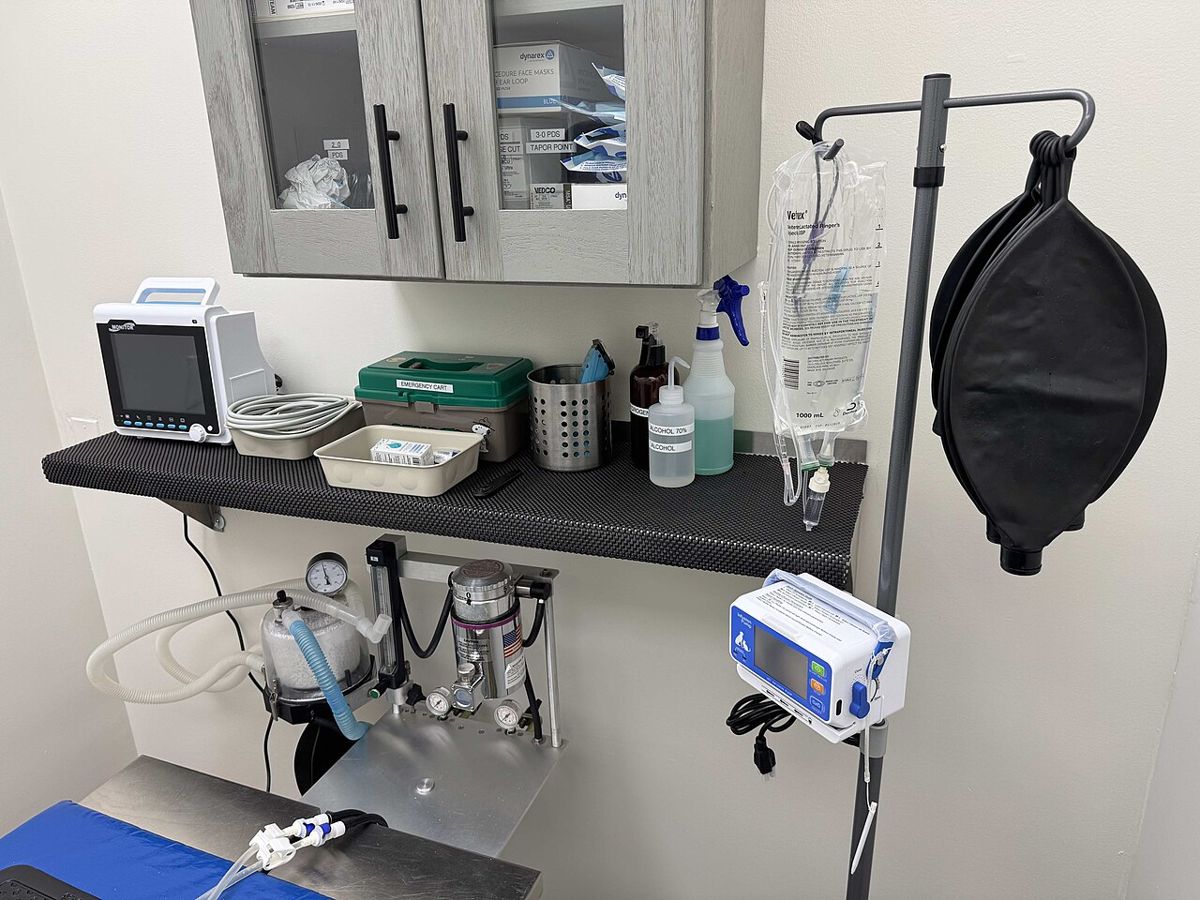
Modern precision vaporizers have two chambers, a vaporizing chamber and a bypass. A portion of the oxygen flows through the vaporizing chamber, the rest bypasses it, and the two rejoin to give the concentration set on the dial.4 A precision vaporizer is concentration calibrated (variable bypass), flow-over, temperature compensated, agent specific and high resistance.4 High resistance is acceptable because pressure from the gas supply, not the patient's breathing, pushes gas through it. A vaporizer placed inside the breathing circuit must be a special low-resistance draw-over type, because the patient's own breathing pushes gas through it.4 Temperature compensation keeps output steady as the liquid cools during use. Flow compensation has limits; older Fluotec Mark III models are compensated down to about 500 mL/min.4
Isoflurane and sevoflurane have different vapor pressures (238 and 157 mm Hg at 20 C).12 A vaporizer calibrated for one agent will not deliver the dial setting if filled with another. The labels state that each agent should go only in a vaporizer specifically calibrated for it.12 Desflurane needs an electronically controlled vaporizer.3
Factors that change MAC
Many drugs reduce the amount of inhalant a patient needs, which lets the anesthetist turn the vaporizer down. This is the idea behind balanced anesthesia. The technician sees it as a patient who stays at a surgical plane with a lower dial setting.
| Factor | Reported effect | What the technician does |
|---|---|---|
| Hypothermia | Significantly reduces MAC by lowering metabolic rate | Warm the patient; reassess depth as temperature falls |
| Nitrous oxide 70% | Lowered isoflurane MAC by 32% in dogs | Expect a lower vaporizer setting |
| Lidocaine CRI | Lowered isoflurane MAC by 27.3% in dogs | Watch for a deeper plane after the infusion starts |
| Dexmedetomidine CRI | Lowered isoflurane MAC by 43.4% in dogs | Same |
| Lidocaine plus dexmedetomidine | Lowered isoflurane MAC by 60.9% in dogs | Same |
| Oral gabapentin before anesthesia (cats) | Lowered isoflurane MAC by about 32% in cats | Note premedication on the record |
Sources: Today's Veterinary Nurse;9 canine and feline MAC studies.678
Nitrous oxide
Nitrous oxide (N2O) gives analgesia and reduces the volatile agent needed, which means less cardiovascular depression. Its potency in dogs is only about half that in people, so the sparing effect is smaller, and its use in dogs is not widespread.3 Reported MAC values for N2O in dogs are 188% to 222%, so it can never produce anesthesia alone at normal pressure.6 N2O diffuses readily from one gas-filled space in the body to another.12 For that reason it is a poor choice for any patient with gas trapped in a closed space. Machines that use N2O should have an oxygen pressure warning alarm and a nitrous oxide cut-off device.4
Procedure: filling and using the vaporizer
- Confirm the agent on the bottle matches the label on the vaporizer. In Figure 4, the bottle collars are color coded.
- Fill in a well-ventilated area or under a hood, and preferably at the end of the day, to reduce staff exposure.5
- Close the filler port and wipe up any spill. Spills during filling add to room contamination.5
- Run the machine check and leak test before each patient. (See the machine and breathing systems guide.)
- Turn the vaporizer on only after the breathing circuit is connected to the intubated patient.5
- For isoflurane in dogs, a common induction setting is 3 to 4% with oxygen at 60 mL/kg/min, reduced to 1 to 3% for maintenance with oxygen at 20 mL/kg/min.3 Follow the veterinarian's plan.
- Monitor reflexes, heart rate, blood pressure and breathing after every dial change. Report hypotension or respiratory depression; the usual first step is to lower the setting.1
- At the end, turn the vaporizer off, keep the patient on oxygen and keep the circuit connected so exhaled agent goes to the scavenger. Patients exhale waste gas during recovery.5
Flowchart: smelling anesthetic gas in the room
Species differences
- Dogs: label MAC is 1.28% isoflurane and 2.36% sevoflurane.21 For mask induction with sevoflurane alone, inspired concentrations up to 7% give surgical anesthesia in a healthy dog in 3 to 14 minutes.1
- Cats: cats are sensitive to the cardiovascular and respiratory depressant effects of inhalants. Large falls in mean arterial pressure have been reported with isoflurane below 1 MAC.10 Reported isoflurane MAC in cats averages 1.71%, higher than in dogs.8 A fit, unsedated cat may strongly resent a mask, so many anesthetists use an induction chamber instead.3
- Horses: isoflurane MAC is 1.31% in horses, and the label covers induction and maintenance in horses and dogs.2
- Birds: nitrous oxide spreads into gas-filled spaces. In pelicans, which have air pockets under the skin, it can cause subcutaneous emphysema.12
Calculation
Worked example: estimating a surgical end-tidal target. A healthy dog is maintained on sevoflurane. The label MAC in dogs is 2.36%, and surgical levels are typically 1.3 to 1.5 times MAC.1
Low end: 2.36% x 1.3 = 3.07% (about 3.1%)
High end: 2.36% x 1.5 = 3.54% (about 3.5%)
The multiplier has no units, so the answer stays in percent. Expected end-tidal sevoflurane at a surgical plane: about 3.1% to 3.5%. The same math for isoflurane (1.28%) gives about 1.7% to 1.9%. Premedication, infusions and hypothermia lower these numbers, so the patient's reflexes and vital signs always decide the final setting.
Safety, legal and client education
- Short-term waste gas exposure can cause fatigue, headache, dizziness and irritability. Long-term effects under study include reproductive, neurological and blood effects.5
- NIOSH limits: 2 ppm of a halogenated agent used alone (not exceeding 1 hour), 0.5 ppm when combined with nitrous oxide, and 25 ppm time-weighted average for nitrous oxide alone.5
- Masks and induction chambers increase exposure; low-flow techniques, leak testing, vaporizer servicing and scavenging reduce it. Operating rooms should have at least 15 air changes per hour.5
- Current evidence suggests that with proper scavenging and ventilation, exposed female veterinarians do not have a higher risk of reproductive problems.5 Staff who are pregnant should still talk to their supervisor about tasks such as mask induction.
- Carbon dioxide absorbent: halogenated agents can react with desiccated (dried-out) absorbent to produce carbon monoxide. Sevoflurane also reacts with soda lime to form Compound A, which rises with higher sevoflurane concentrations and lower fresh gas flows. Potassium hydroxide absorbents such as Baralyme are not recommended with sevoflurane.1
- The color indicator may not change when absorbent dries out, so replace absorbent routinely regardless of color.1

Common mistakes and exam traps
- Higher MAC means less potent, not more. Sevoflurane has a higher MAC than isoflurane, so it is less potent.
- Faster induction comes from low blood solubility, not from potency.
- 1 MAC is not a surgical plane. Half of patients still move at 1 MAC; plan for 1.3 to 1.5 times MAC.
- Do not rely on absorbent color alone. Dried absorbent may not change color.
- Do not turn the vaporizer on before the patient is connected; this vents agent into the room.
- Nitrous oxide cannot be the only anesthetic; its MAC in dogs is about 200%.
Memory aids
LOW MAC, LOTS OF KICK: a low MAC means a potent agent, so isoflurane (about 1.3% in dogs) is more potent than sevoflurane (about 2.3%) (memory aid).
LOW SOLUBILITY, LEAVES SOON: a low blood/gas coefficient means fast induction and fast recovery, as with sevoflurane at 0.63 to 0.69 (memory aid).
ONE-THIRD TO ONE-HALF MORE: surgical anesthesia usually needs 1.3 to 1.5 times MAC (memory aid).
2, HALF, 25: NIOSH limits of 2 ppm halogenated agent alone, 0.5 ppm with nitrous oxide, 25 ppm nitrous oxide alone (memory aid).
SEVO UP TO SEVEN: mask induction with sevoflurane alone in healthy dogs uses inspired concentrations up to 7% (memory aid).
Quick review
- MAC is the alveolar concentration at which 50% of patients do not respond to a noxious stimulus.
- Surgical anesthesia is typically 1.3 to 1.5 times MAC.
- Dog MAC: isoflurane 1.28%, sevoflurane 2.36% (labels).
- Lower MAC means higher potency.
- Lower blood/gas coefficient means faster induction and recovery; sevoflurane is less soluble than isoflurane.
- Precision vaporizers are agent specific, temperature compensated, variable bypass and out of circuit.
- Inhalants cause dose-dependent hypotension and respiratory depression; turn down the vaporizer first.
- Hypothermia, nitrous oxide, lidocaine, dexmedetomidine and gabapentin lower MAC.
- Nitrous oxide is an adjunct only and moves into closed gas spaces.
- Replace CO2 absorbent routinely; avoid potassium hydroxide absorbents with sevoflurane.
- Fill vaporizers in ventilated areas and turn them on only after the patient is connected.
- NIOSH: 2 ppm halogenated alone, 0.5 ppm with N2O, 25 ppm N2O.