Introduction
Most of the surgery in general practice is a short list of procedures: spays, neuters, cesarean sections, bladder stone removal, foreign body surgery, gastropexy and mass removal. The surgeon cuts and sutures. The technician makes the procedure possible: the right clip, the right position, the right pack, a ready neonatal station, a correctly fixed biopsy and a patient that is watched for the complication each procedure is known for. This guide walks through each procedure from the technician's side of the table, with the terms, positions, instruments and post-op warning signs that the VTNE expects you to know.
Key facts
- A canine spay is done in dorsal recumbency, clipped from xiphoid to pubis and out to the mammary chain.3
- An ovariohysterectomy removes the ovaries and uterus; the pedicles are clamped with Carmalt forceps in larger dogs and Crile or mosquito forceps in small patients.27
- Canine castration uses a prescrotal incision; the scrotum itself is not clipped.11
- An open castration incises the vaginal tunic; a closed castration leaves it intact and needs at least one transfixing ligature.1213
- Never swing a newborn to clear fluid; rub, dry, suction gently and keep it warm.20
- Intestinal dehiscence most often occurs 3 to 5 days after surgery.26
- A gastropexy fixes the stomach to the right abdominal wall to prevent GDV recurrence.2728
- Biopsy tissue goes in 10% neutral buffered formalin, ideally 10 parts formalin to 1 part tissue.31
How the VTNE tests this
- Define a procedure from its name, for example cystotomy versus cystostomy, or gastrotomy versus gastropexy (Domain 2 Task A; K16).1
- Choose the position, clip area or instrument for a named procedure.
- Recognize the complication to watch for after a procedure, such as hemorrhage after a spay or peritonitis after an enterotomy.
- Take over a puppy or kitten handed off at a cesarean section and choose the next resuscitation step.
- Calculate the formalin volume needed for a biopsy specimen.
Core concepts
Reading the name of a procedure
Most surgical names are a prefix for the organ plus a suffix for what is done.2
- -otomy: cut into, then close. A cystotomy opens the bladder, often to remove stones. A gastrotomy opens the stomach.
- -ectomy: remove. An ovariohysterectomy (OHE or OVH) removes the ovaries and uterus.
- -stomy: create a new opening, such as a tube gastrostomy for feeding or a urethrostomy.
- -pexy: fix in place. A gastropexy attaches the stomach to the body wall.
- -rrhaphy: suture or repair, such as a herniorrhaphy.
- Celiotomy is the correct term for a midline incision into the abdomen. Laparotomy is used the same way, but strictly means a flank approach.
An ovariectomy (OVE) removes only the ovaries and leaves the uterus. It can be done open or by laparoscopy. Studies comparing open OVE with OVH found no difference in complications or pain scores.32 An onychectomy (declaw) is amputation of the third phalanx (P3), not removal of the claw alone.30
Where the spay ligatures go
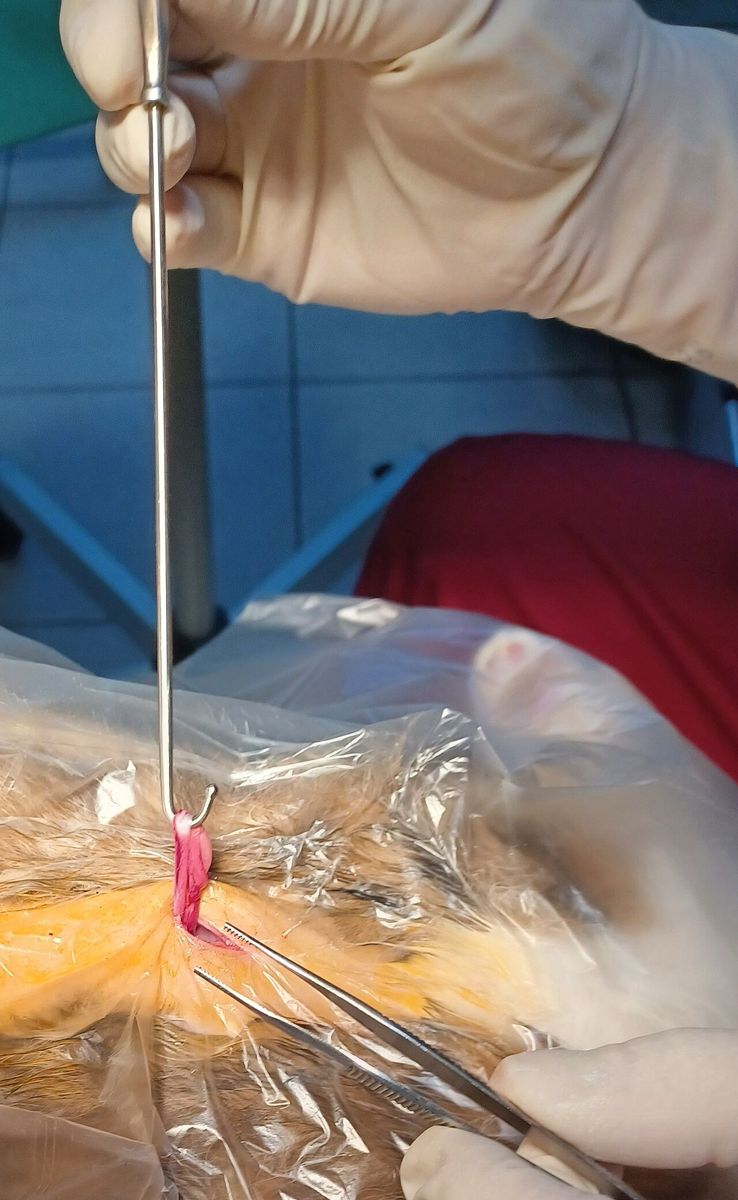
In an OVH the surgeon ligates three sites: the left ovarian pedicle, the right ovarian pedicle and the uterine body just cranial to the cervix. Before the left pedicle can be brought up to the incision, the surgeon stretches and breaks the suspensory ligament, a taut band running from the ovary toward the kidney.6 The cervix stays in the patient.9
Procedure or technique
Ovariohysterectomy (spay)
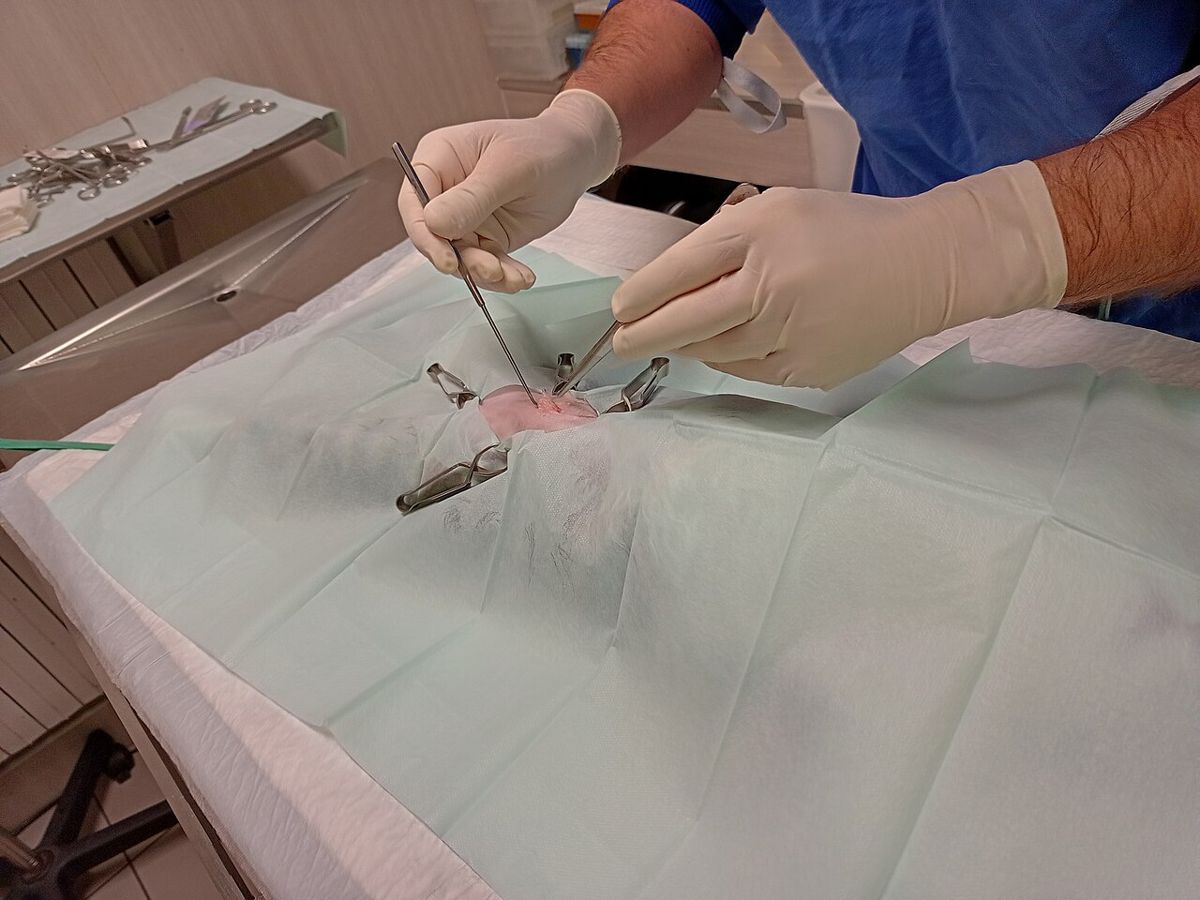
- Place the patient in dorsal recumbency. Clip and prep from xiphoid to pubis and out to the mammary chain, so the incision can be extended if bleeding is a problem.3
- Expect the dog incision to start at or just caudal to the umbilicus. In cats it sits a little more caudal, centered on the middle third between umbilicus and pubis.4
- Have a spay hook (ovariohysterectomy hook) on the tray. The surgeon retracts the left abdominal wall and inserts the hook to pick up the left uterine horn, which is easiest to find.5
- Pass Carmalt forceps for the pedicles in medium and large dogs. Carmalts are usually too big for small dogs and cats, which get Crile or mosquito forceps.7
- Load absorbable suture such as PDS, Vicryl or Biosyn, usually 2-0 or 3-0. Size 0 may be needed for fatty pedicles in giant dogs, and 4-0 for very small cats.8
- Count sponges and instruments before closure, as for any celiotomy.
Castration (orchiectomy)
- Dog: dorsal recumbency. Clip and prep the prescrotal area. Do not clip the scrotum, which causes inflammation and self-trauma after surgery.11
- Open technique: the surgeon incises the vaginal tunic and ligates the testicular artery, pampiniform plexus and ductus deferens. Closed technique: the tunic is left intact and at least one transfixing ligature is placed to stop slippage.1213
- Three Carmalt clamps go across the spermatic cord, with absorbable ligatures.13 Skin is closed with nonabsorbable sutures or an intradermal absorbable pattern with a buried knot.14
- Cat: lateral recumbency, bilateral scrotal incisions. The scrotal hair is plucked rather than shaved because it is less irritating.15
- Cryptorchid: a retained testis can be abdominal, inguinal or prescrotal. Palpation is easiest under anesthesia in dorsal recumbency, so prep a wider area until the testis is found.33
Cesarean section and the neonate hand-off
- Clip and do the first skin prep before induction to shorten the time the puppies are exposed to anesthetic drugs. The surgeon scrubs and gowns while the dam is induced.17
- The surgeon incises the ventral uterine body, removes each fetus, opens the amniotic sac, double clamps and cuts the umbilical structures and passes the newborn to a non-sterile assistant.18
- Take the newborn in a warm towel. Do not let the surgeon pass it by the umbilical clamp, which can cause an umbilical hernia.18
- Follow the resuscitation steps in Figure 3. The team counts newborns against the number expected; the surgeon palpates the uterus from ovary to body to make sure none is left.18
- Skin staples or an intradermal closure are preferred because the puppies will nurse against the incision.19
Cystotomy
Before surgery, urethral stones are flushed back into the bladder (retrohydropulsion) and a urinary catheter is often left in place so they cannot slip back.21 The approach is a caudal midline celiotomy. The surgeon places stay sutures and packs off the bladder with moist laparotomy sponges. Have suction ready. The bladder is closed with rapidly absorbable monofilament such as Monocryl or Biosyn; chromic gut and Dexon lose strength too fast in urine. Your jobs afterward: submit the stones for analysis and culture, and position the post-op radiographs that confirm every stone is gone.22
Enterotomy and resection and anastomosis
An enterotomy opens viable bowel to remove a foreign body. A resection and anastomosis removes nonviable bowel and joins the healthy ends. Surgeons favor enterotomy when the bowel is viable because dehiscence is reportedly more common after resection and anastomosis.24 Set up a separate "dirty" instrument field (blade, thumb forceps, Metzenbaum scissors, needle holder, suture scissors and an Allis or similar forceps). Those instruments, the suction tip and the gloves are changed once the bowel is closed and before the abdomen is closed.23 Closure is usually 3-0 or 4-0 PDS or Biosyn on a taper needle, never chromic gut. Have warm saline ready: the closure is leak tested, then omentalized.25
Gastropexy
A gastropexy is done to prevent GDV in high-risk dogs or to prevent recurrence after GDV. The incisional technique is preferred.27 A partial-thickness incision in the pyloric antrum34 is sutured to a matching incision in the right body wall, caudal to the ribs and 3 to 5 cm from the midline. Towel clamps on the right body wall help expose it.28 After surgery for GDV, monitoring includes continuous ECG, blood pressure, PCV and total solids, electrolytes, glucose and lactate.29
Mass removal
Ask the surgeon how the specimen should be handled before it is dropped in a jar. Fix tissue for histopathology in 10% neutral buffered formalin, at least 5:1 formalin to tissue and ideally 10:1, in a sealed, leak-proof, wide-mouth plastic container. Glass jars are not accepted by the laboratory.31 Label the jar with the patient, the site and the date.
| Procedure | Position and clip | Key instruments and supplies | Watch for after surgery |
|---|---|---|---|
| OVH, dog or cat | Dorsal; xiphoid to pubis | Spay hook, Carmalt (Crile or mosquito in cats), absorbable suture | Hemorrhage (pale membranes, weak pulse, swelling), incision problems; later, heat signs from an ovarian remnant |
| Castration, dog | Dorsal; prescrotal clip, scrotum not clipped | Carmalt clamps, absorbable ligature | Scrotal swelling, bruising, scrotal hematoma, abdominal hemorrhage, infection |
| Castration, cat | Lateral; scrotal hair plucked | Small drape, mosquito forceps | Swelling, bleeding |
| Cesarean section | Dorsal; clipped before induction | Towels, extra hemostats, neonatal station, reversal drugs | Dam: bleeding, uterine discharge; newborns: breathing, temperature, nursing |
| Cystotomy | Dorsal; caudal abdomen | Stay sutures, laparotomy sponges, suction, stone container | Urine leakage, retained stones on post-op radiographs |
| Enterotomy or R and A | Dorsal; xiphoid to pubis | Dirty field, Allis forceps, saline for leak test | Dehiscence and septic peritonitis, most often days 3 to 5 |
| Gastropexy | Dorsal; whole ventral abdomen | Balfour retractor, towel clamps, stay suture | Arrhythmias and shock after GDV; incision checks |
Sources: Veterinary Surgery Online chapters 6 to 14 (refs 3 to 28); Merck Veterinary Manual (refs 26, 29). Post-op signs for OVH and castration from the complication lists in refs 10 and 16; uroabdomen and GDV arrhythmia notes are general reminders for the technician.
Flowchart
Species differences
| Point | Dog | Cat |
|---|---|---|
| Spay incision site | Cranial third between umbilicus and pubis | Slightly more caudal, centered on the middle third |
| Pedicle forceps | Carmalt in medium and large dogs | Crile, or mosquito in thin cats |
| Uterus | Friable if recently in heat | Friable; clamp with care or not at all |
| Castration approach | Dorsal, single prescrotal incision | Lateral, two scrotal incisions, hair plucked |
| Castration technique | Open or closed | Open |
Sources: refs 4, 7, 9, 11 and 15.
GDV is mainly a disease of large, deep-chested dogs. Breeds at risk include Great Danes, German Shepherd Dogs, Irish and Gordon Setters, Weimaraners, Saint Bernards, Standard Poodles and Basset Hounds, which is why a prophylactic gastropexy is sometimes done at the time of spay or neuter.2927
Calculation
Worked example: formalin for a mass. A skin mass is about 3 cm by 2 cm by 2 cm. How much 10% neutral buffered formalin do you need at the ideal 10:1 ratio?31
Tissue volume: 3 cm x 2 cm x 2 cm = 12 cm3 = 12 mL (1 cm3 = 1 mL).
Formalin: 12 mL tissue x (10 mL formalin / 1 mL tissue) = 120 mL formalin.
The minimum acceptable is 5:1, or 60 mL. Choose a wide-mouth plastic jar that holds the 120 mL with room for the tissue. A box volume overestimates a round mass, so this errs on the side of more formalin.
Safety, legal and client education
- Formalin is a hazardous chemical: wear gloves, pour in a ventilated area and keep jars sealed.
- Clients must sign informed consent. Explain in plain words what an OVH removes and that the patient will not come into heat afterward.2
- After a spay, signs of heat weeks to months later suggest an ovarian remnant, so ask the owner to call if they see them.10
- After castration, tell owners that some scrotal swelling is expected, but a scrotal hematoma or a red, draining incision needs a recheck.16
- After foreign body surgery, ask owners to report vomiting, lethargy, poor appetite or a painful belly at once, especially on days 3 to 5.26
- For declaw requests, be ready to explain that the procedure amputates the last bone of each toe.30 Follow your practice and state policy, since some jurisdictions restrict it.
Common mistakes and exam traps
- -otomy is not -ostomy. A cystotomy is opened and closed; a cystostomy leaves an opening, such as a tube.
- Clipping the scrotum for a canine neuter is wrong; only the prescrotal area is clipped.
- Swinging newborns is not recommended; RECOVER cites the risk of intracranial hemorrhage, trauma and aspiration.20
- Doxapram is not routine for every C-section newborn; it is used only in newborns that fail to respond to other supportive measures.20
- Chromic gut is the wrong choice for bladder or bowel closure.2225
- Onychectomy is P3 amputation, not a nail trim or claw removal.
Memory aids
OTOMY OPENS, ECTOMY EXITS, PEXY PINS: -otomy cuts in and closes, -ectomy removes, -pexy fixes an organ in place (memory aid).
THREE TIES FOR A SPAY: left pedicle, right pedicle, uterine body; the cervix stays (memory aid).
CLOSED NEEDS A CROSS: a closed castration needs at least one transfixing ligature (memory aid).
WARM, DRY, CLEAR, BREATHE: the order of newborn support at C-section, and never swing (memory aid).
THREE TO FIVE, WATCH THE GUT: intestinal dehiscence peaks 3 to 5 days after surgery (memory aid).
TEN TO ONE FOR THE JAR: 10 parts formalin to 1 part tissue (memory aid).
Quick review
- OVH removes ovaries and uterus; OVE removes ovaries only.
- Spay: dorsal recumbency, clip xiphoid to pubis.
- Spay ligation sites: both ovarian pedicles and the uterine body cranial to the cervix.
- Carmalts for large pedicles; Crile or mosquito in cats.
- Dog castration: prescrotal incision, scrotum not clipped.
- Closed castration: tunic intact, transfixing ligature.
- Cat castration: lateral recumbency, scrotal hair plucked, open technique.
- C-section: clip before induction; newborns dried, rubbed, warmed, suctioned gently, never swung.
- Reverse the dam's opioid, alpha-2 agonist or benzodiazepine in newborns needing resuscitation.
- Cystotomy: submit stones for analysis and culture; post-op radiographs confirm removal.
- Bowel surgery uses a dirty field; dehiscence peaks days 3 to 5.
- Gastropexy pins the pyloric antrum to the right body wall.